
 DNA Synthesis
 Vector Selection
 Molecular Biology
 Oligo Synthesis
 RNA Synthesis
 Variant Libraries
 Genome KO Library
 Oligo Pools
 Virus Packaging
 Gene Editing
 Protein Expression
 Antibody Services
 Peptide Services
 DNA Data Storage
 Standard Oligo
 Standard Genome KO Libraries
 Standard Genome Editing Plasmid
 ProXpress
 Protein Products
Modern biotechnology depends on the ability to construct long, accurate sequences of genetic material without relying on a natural template. At Synbio Technologies, we define whole gene synthesis as the de novo creation of double-stranded DNA molecules that can range from a few hundred base pairs to several kilobases in length. This capability is fundamentally different from simple oligonucleotide production because it involves the assembly of multiple fragments into a single, cohesive genetic unit. By utilizing whole gene synthesis, researchers can create entirely new metabolic pathways, optimize codon usage for specific host organisms, or engineer novel proteins that do not exist in nature. Our approach combines traditional molecular biology techniques with advanced computational tools to ensure that every sequence is delivered with 100% accuracy. As the field evolves, whole gene synthesis continues to provide the essential building blocks for synthetic biology, drug discovery, and agricultural improvements.
Foundations of Standard Gene Synthesis
The initial phase of constructing a gene involves breaking down the desired sequence into smaller, overlapping oligonucleotides that can be chemically manufactured. During standard gene synthesis, these short fragments are designed to have specific melting temperatures and minimal secondary structures to facilitate smooth assembly. Once the oligonucleotides are synthesized, we use polymerase-based or ligase-based methods to stitch them together into larger segments. This standard gene synthesis workflow is highly reliable for sequences of moderate complexity and length. However, we must carefully monitor the assembly process to prevent errors such as insertions, deletions, or substitutions that can occur during the thermal cycling phases. By maintaining strict environmental controls and using high-fidelity enzymes, we ensure that the standard gene synthesis process yields a high percentage of correct clones, which are then verified through comprehensive sequencing.
Integration of AI-powered Gene Synthesis
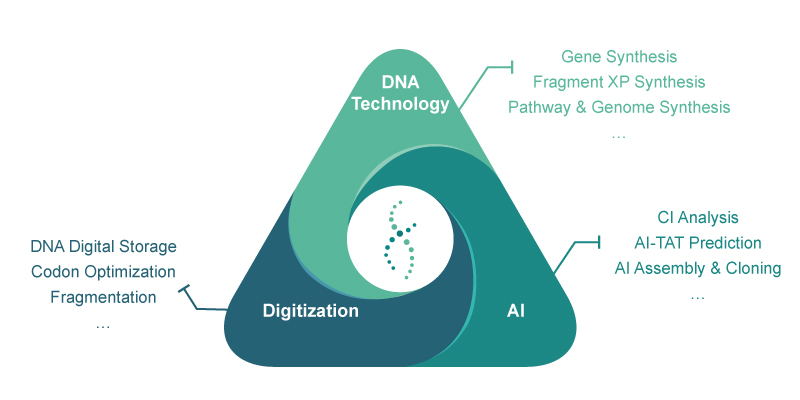
As sequences become longer and more repetitive, traditional design methods sometimes reach their limits, necessitating the use of more sophisticated computational strategies. We have integrated AI-powered gene synthesis algorithms to predict and mitigate potential assembly failures before the physical synthesis even begins. These digital tools analyze the primary sequence for "difficult" regions, such as hairpins or extreme GC content, and suggest alternative codon optimizations that maintain protein function while easing the manufacturing process. By leveragingAI-powered gene synthesis, we can significantly increase the success rate of complex projects that would otherwise be prone to failure in a traditional lab setting. This predictive capability allows us to streamline the entire production timeline, ensuring that even the most challenging whole gene synthesis orders are fulfilled with precision. The synergy between machine learning and laboratory automation is what makes AI-powered gene synthesis an indispensable asset for large-scale genomic engineering.
Scaling Up With Whole Gene Synthesis
The final stage of the process involves cloning the assembled gene into a vector and verifying its sequence via Next-Generation Sequencing or Sanger sequencing. For large-scale projects, whole gene synthesis must be performed in parallel across hundreds or thousands of different targets. We utilize high-density plates and robotic liquid handling to manage this volume, ensuring that every individual gene is tracked and validated. While standard gene synthesis might focus on individual constructs, a high-throughput whole gene synthesis platform is designed for library construction and metabolic pathway engineering. We also implement rigorous error-correction steps, utilizing specific endonucleases to remove mismatched DNA duplexes from the pool. This attention to detail during the scaling phase is what separates a successful project from one plagued by sequence inconsistencies. Whether the goal is a single gene or a massive library, the principles of AI-powered gene synthesis help us maintain the highest levels of fidelity throughout the scale-up.
Scientific progress relies on the availability of high-quality genetic tools that can be customized to meet specific experimental needs. At Synbio Technologies, we are committed to advancing the methods of whole gene synthesis to provide our partners with the most accurate and reliable DNA constructs possible. By balancing the reliability of standard gene synthesis with the innovative potential of AI-powered gene synthesis, we offer a comprehensive solution for modern genetic engineering. Our team works tirelessly to refine these processes, ensuring that every base pair is exactly where it needs to be for your research to succeed. We believe that by mastering the complexities of whole gene synthesis, we can help the global scientific community address some of the most pressing challenges in human health and environmental sustainability. Our dedication to quality and transparency remains our guiding principle as we support the next generation of biological discovery.