
 DNA Synthesis
 Vector Selection
 Molecular Biology
 Oligo Synthesis
 RNA Synthesis
 Variant Libraries
 Genome KO Library
 Oligo Pools
 Virus Packaging
 Gene Editing
 Protein Expression
 Antibody Services
 Peptide Services
 DNA Data Storage
 Standard Oligo
 Standard Genome KO Libraries
 Standard Genome Editing Plasmid
 ProXpress
 Protein Products
The use of qPCR Probe Fluorescence Signal is pivotal in understanding the efficiency and accuracy of quantitative PCR experiments. This technology not only enables enhanced detection of specific DNA sequences but also provides insights into their abundance in various samples. At Synbio Technologies, we are dedicated to exploring the intricate relationships between PCR fluorescence, fluorophores, and quenchers, allowing researchers to optimize their experiments and achieve reliable results with low cycle threshold (Ct) values.
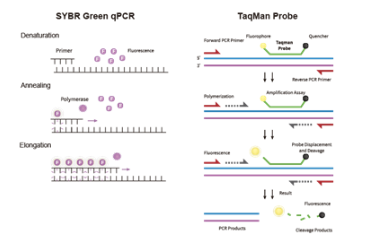
Understanding the Basics of qPCR Fluorescence
The qPCR fluorescence technology operates on a simple yet effective principle. During PCR amplification, the targeted DNA sequences are concurrently labeled with fluorophores. These are fluorescent molecules that emit light when excited by a specific wavelength. Also integral to this process are quenchers, which absorb the fluorescence emitted by the fluorophores, thus maintaining control over the emission levels. This delicate balance between the two components shapes the qPCR Probe Fluorescence Signal, which indicates the amplification efficiency of the target DNA.
In a successful qPCR run, we expect that as the number of DNA copies increases, so too does the fluorescence signal. The fluorescence is measured in real-time, allowing researchers to plot amplification curves that can be analyzed for quantitative data. The higher the signal intensity, the more robust the amplification, often culminating in a lower Ct value, signifying an efficient reaction.
Factors Influencing Ct Values and Fluorescence Signals
Several key factors influence Ct values, including the initial template concentration, the efficiency of the polymerase enzyme used, and the quality of the reagents. A critical aspect at Synbio Technologies is ensuring that the qPCR probes are designed to minimize non-specific binding, which can skew results and lead to higher Ct values. By optimizing the concentration of fluorophores and quenchers, we can enhance the qPCR Probe Fluorescence Signal, resulting in a clearer, more interpretable amplification curve.
Moreover, the configuration of the fluorophore-quencher system plays a significant role in the outcome. For instance, using a tandem dye system can improve sensitivity, allowing for the detection of lower quantities of target DNA without compromising on the signal clarity. This optimization leads to more reliable quantitative analysis, as evidenced by the linear relationship observed during the plateau phase of amplification.
Enhancing Your qPCR Experimentation with Quality Reagents
Selecting the right reagents is crucial in maximizing the effectiveness of qPCR experiments. At Synbio Technologies, we offer a range of premium qPCR probes designed to provide consistent performance. Our focus is on developing high-quality fluorophores and quenchers that work optimally together, ensuring that researchers achieve the best possible results in their quantitative assessments of DNA.
Researchers must also consider the operational conditions during the PCR process, such as temperature cycles and duration. These factors can significantly impact the robustness of the PCR fluorescence signal and, consequently, the interpreted Ct values. Proper training and protocol adherence can further aid in successfully navigating these variables for reliable outcomes.
Conclusion
In conclusion, understanding the science behind low cycle threshold (Ct) values and their correlation with the qPCR Probe Fluorescence Signal is vital for accurate and meaningful quantitative PCR results. By focusing on the delicate interactions between fluorophores and quenchers, and optimizing experimental conditions, we can enhance PCR efficiency and signal clarity. At Synbio Technologies, we remain committed to equipping researchers with high-quality reagents that facilitate precise DNA quantification, ensuring advancements in biotechnology and molecular biology research. Achieving accurate results in fluorophore and quencher not only relies on the underlying principles but also on the careful selection of tools and reagents that foster successful experimentation.