
 DNA Synthesis
 Vector Selection
 Molecular Biology
 Oligo Synthesis
 RNA Synthesis
 Variant Libraries
 Genome KO Library
 Oligo Pools
 Virus Packaging
 Gene Editing
 Protein Expression
 Antibody Services
 Peptide Services
 DNA Data Storage
 Standard Oligo
 Standard Genome KO Libraries
 Standard Genome Editing Plasmid
 ProXpress
 Protein Products
When conducting qPCR experiments, the fluorescence signal is pivotal to accurate DNA quantification. At Synbio Technologies, we recognize that the selection of fluorophores and quenchers is crucial for enhancing the sensitivity and detection limits of qPCR assays. The right combination ensures that your results are both reliable and precise, making it possible to detect even the smallest amounts of target DNA. Understanding how these components work together can help optimize your experiments for better accuracy.
Fluorophore Selection and Signal Sensitivity
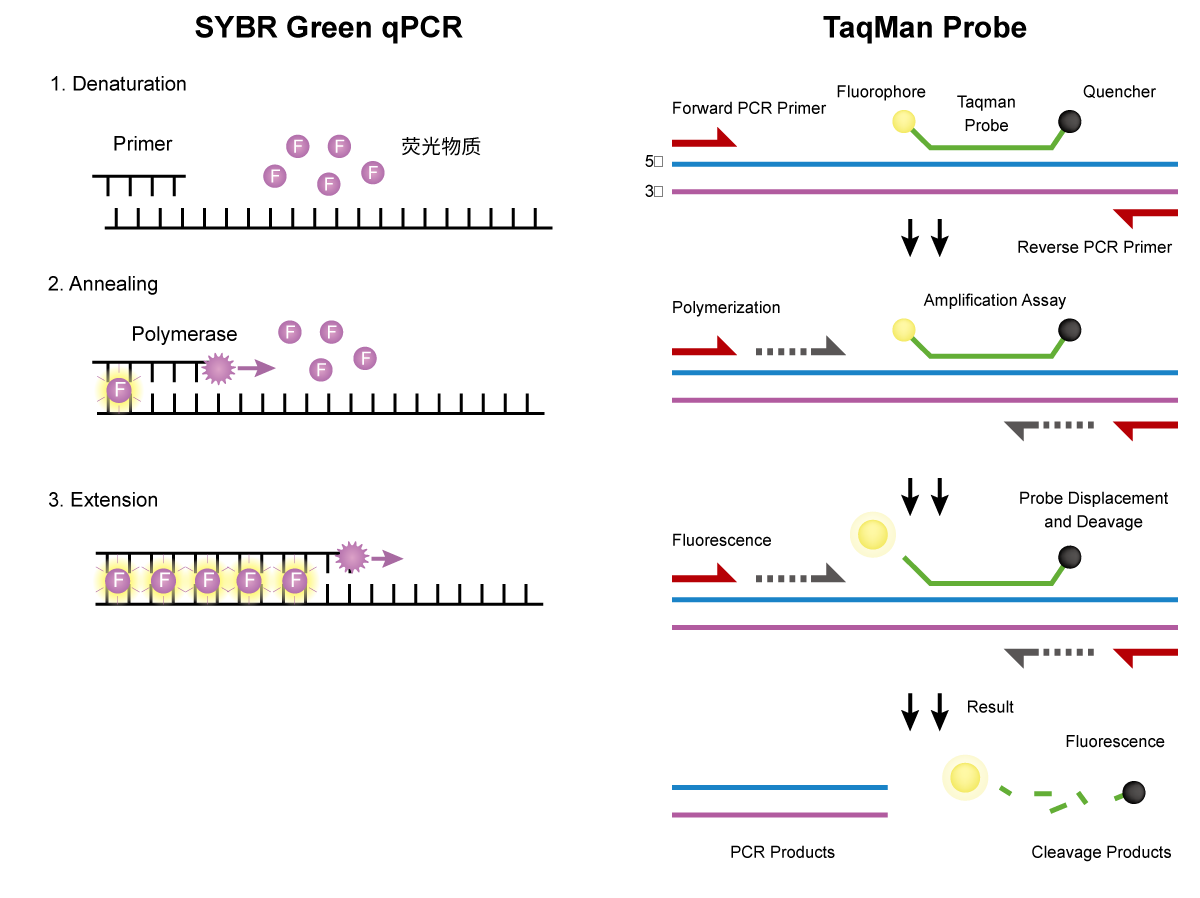
Fluorophores are central to generating the fluorescence signals in qPCR experiments. The type of fluorophore chosen has a direct impact on the signal strength and the sensitivity of detection. At Synbio Technologies, we understand the importance of selecting the right fluorophore for each application. By choosing fluorophores with higher quantum yields, we ensure that your qPCR experiments can detect lower concentrations of target DNA, improving detection limits and overall assay sensitivity. The key is to select a fluorophore that works well with the qPCR instrument’s detection capabilities.
Quencher Selection and Signal Modulation
In addition to the fluorophore, the quencher plays an equally important role in controlling the fluorescence signal. Quenchers are molecules that absorb the emitted light from the fluorophore, preventing fluorescence from occurring until the probe binds to its target sequence. The efficiency of the quencher can affect the overall signal strength and accuracy of your qPCR data. At Synbio Technologies, we offer a variety of quencher options, ensuring that the combination with the fluorophore is optimized for the best results. Selecting the appropriate quencher is essential to avoid issues like background noise, which can interfere with the accuracy of the qPCR Probe Fluorescence Signal.
Optimizing Fluorophore and Quencher Combinations
To achieve optimal performance, it's essential to consider the interaction between the fluorophore and quencher. If the distance between them is too great, the signal can be weak, while too close a distance can result in inefficient quenching. At Synbio Technologies, we specialize in fine-tuning the fluorophore-quencher combinations for each specific application. This optimization ensures that your qPCR probes provide strong, consistent signals, improving the detection limits and overall accuracy of your experiment.
Conclusion
The selection of the right fluorophore and quencher is crucial for maximizing the performance of qPCR assays. It directly influences the strength and accuracy of fluorescence signals, which are vital for reliable DNA quantification. At Synbio Technologies, we provide high-quality, customizable qPCR probes that ensure the most efficient fluorophore-quencher combinations for your research. With our expertise, we can help you improve detection limits and achieve the highest possible sensitivity in your experiments.