
 DNA Synthesis
 Vector Selection
 Molecular Biology
 Oligo Synthesis
 RNA Synthesis
 Variant Libraries
 Genome KO Library
 Oligo Pools
 Virus Packaging
 Gene Editing
 Protein Expression
 Antibody Services
 Peptide Services
 DNA Data Storage
 Standard Oligo
 Standard Genome KO Libraries
 Standard Genome Editing Plasmid
 ProXpress
 Protein Products
The rapid expansion of synthetic biology, functional genomics, and personalized medicine has created an unprecedented demand for large-scale, high-fidelity DNA synthesis. Traditional synthetic methods no longer suffice for modern high-throughput experiments.
This has catalyzed the rise of oligo pools, which are complex mixtures of thousands to millions of unique, user-defined DNA sequences synthesized in parallel using microarray-based platforms and delivered as a mixed pool.
These pools serve as the foundational building blocks for applications ranging from gene editing libraries to emerging DNA-based data storage, enabling researchers to explore biological complexity at a large scale.
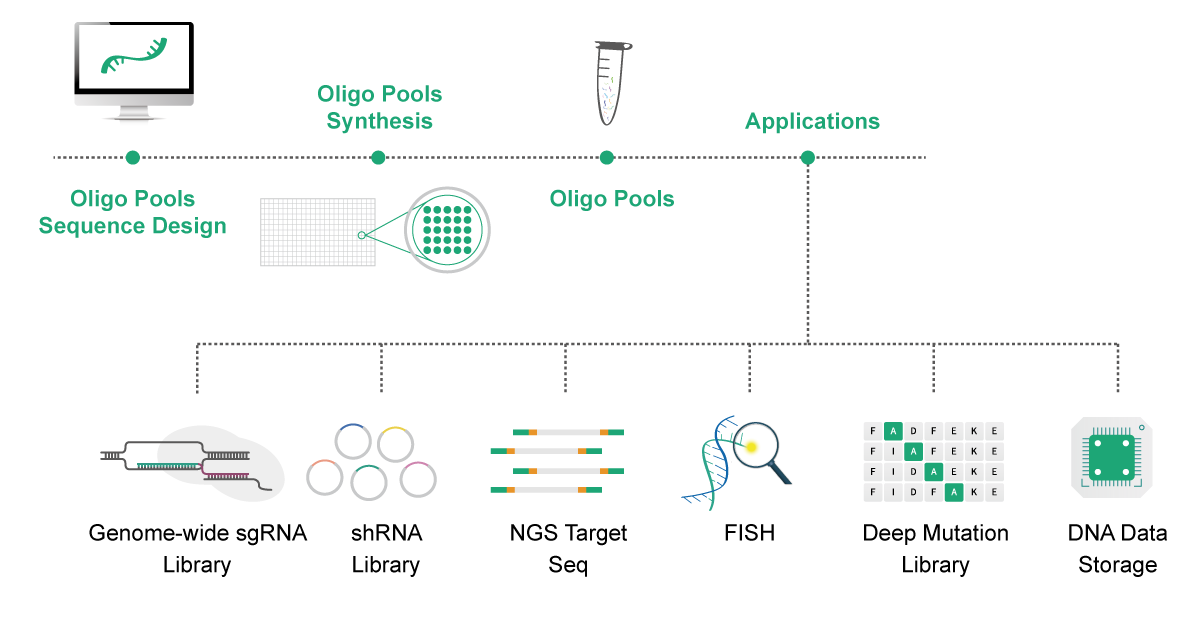
Single Oligos vs. Oligo Pools
Single oligos are ideal for low-complexity tasks like PCR priming, and oligo pool synthesis is essential for any project requiring massive sequence diversity.
|
Feature |
Single Oligo |
Oligo Pool |
|---|---|---|
|
Synthesis Method |
Column-based (Phosphoramidite) |
Microarray-based (Inkjet or Electrochemical) |
|
Throughput |
One sequence per order |
Thousands to millions of sequences |
|
Delivery Format |
Individual tubes or plates |
One single mixed solution |
|
Cost per Sequence |
High |
Extremely Low |
|
Concentration |
High (nmol to µmol) |
Low abundance per individual sequence (typically requiring amplification) |
|
Customization |
Sequential ordering |
Parallel, complex design |
|
Primary Use Case |
PCR, Sanger sequencing, cloning |
sgRNA libraries, NGS capture, variant libraries |
So, what are oligo pools used for in modern research?
The following sections explain their key applications.
CRISPR sgRNA Library
CRISPR screens need thousands of different sgRNA sequences. You want to knock out or edit many genes at once, then see which edits cause a phenotype. With individual oligos, building a genome-wide sgRNA library becomes impractical and prohibitively expensive.
With an oligo pool, you synthesize the entire sgRNA library in one go. Oligo pool services allow for the parallel production of tens of thousands of sgRNA sequences. Oligos are typically designed with guide sequences plus cloning adapters or barcodes, resulting in lengths often ranging from ~60-200 nt. You clone the pool into a lentiviral or other vector, deliver it into cells, and then analyze the results.
This is how scientists find drug targets, essential genes, and mechanisms of resistance.
Variant Library
Oligo pools enable the concurrent synthesis of thousands of gene variants, which is essential for pinpointing key structural and functional sites in protein engineering, metabolic engineering, and antibody optimization.
-
Deep Mutational Scanning: By designing oligo pools that cover all possible single-point mutations in a gene, researchers can identify "hotspots" for antibody optimization or enzyme efficiency.
-
Metabolic Engineering: Variant libraries are used to tune promoter strengths and ribosome binding sites (RBS) within a metabolic pathway. This allows for the optimization of flux toward a desired biofuel or pharmaceutical precursor.
-
Antibody Optimization: For drug development, oligo pool services generate libraries for Complementarity-Determining Regions (CDRs), allowing for the fine-tuning of paratope-epitope interactions to optimize affinity, specificity, and developability.
NGS Hybrid Capture Probe Library
For Next-Generation Sequencing (NGS), oligo pools are used to develop custom hybridization capture probes.
Because hybrid capture requires thousands of unique probes to cover genomic regions uniformly, purchasing individual biotinylated oligos is inefficient. In some workflows, probe precursor sequences are synthesized as an oligo pool and subsequently amplified or converted into capture probes. This provides high-throughput sequencing projects with a cost-effective way to achieve deep coverage enabling deeper coverage of regions of interest while reducing sequencing cost and off-target reads.
High-Throughput Screening
High-throughput screening relies on oligo pools because they enable the simultaneous synthesis of large and diverse oligonucleotide libraries in a single batch. This capability meets the growing demands of synthetic biology, where large-scale testing and rapid iteration are essential.
Compared with traditional gene synthesis methods, oligo pool synthesis offers far greater scalability and efficiency. It enables researchers to construct diverse libraries for functional screening, significantly accelerating discovery workflows.
DNA Data Storage
Perhaps the most futuristic application of oligo pools is DNA data storage. As global data production outpaces the capacity of silicon-based media, the high information density and extreme stability of DNA make it an ideal archival medium.
In this workflow, digital files (0s and 1s) are converted into A, T, C, and G sequences using specialized algorithms. These sequences are then synthesized as oligo pools. A single gram of DNA can theoretically storeover200 petabytes of data, a storage density far surpassing traditional hard drives and Blu-ray discs.
Why Oligo Pools Matter for Research?
-
High Throughput: The ability to synthesize up to hundreds of thousands of unique sequences in a single run accelerates the transition from hypothesis to screening.
-
Cost-Efficiency: By moving synthesis onto a microfluidic or inkjet-based chip, the cost per base is significantly reduced compared to column-based synthesis.
-
Flexible Design: Researchers are no longer limited by "standard" libraries. Sequences in the pool are fully customizable, allowing for the inclusion of specific barcodes, restriction sites, or unique adapters.
-
Wide Applications: From basic research into gene regulation to the industrial-scale production of synthetic vaccines, the versatility of oligo pools makes them a staple in the modern lab.
Challenges & Choosing Your Provider
Despite their benefits, designing oligo pools presents technical hurdles.
-
Synthesis Bias:Sequences with high GC content or complex secondary structures may have lower representation or higher error rates.
-
Error Rates: While decreasing, synthesis errors can lead to frameshifts in variant libraries or ineffective sgRNAs in CRISPR screens.
-
Turnaround time:Pool synthesisgenerallytakes longer than single oligos. Plan your experiments accordingly.
Utilizing advanced inkjet technology, Synbio Technologies can synthesize up to 890,000 unique sequences per chip with lengths up to 300 nt. Over 90% of oligonucleotides exhibit variations within a 2.5-fold difference.
Our customized oligo pool synthesis services perfectly align with clients' downstream experiments and applications, such as sgRNA screening libraries, high-throughput sequencing, high-throughput gene synthesis, and synthetic biology.
If you are searching for an oligo pool service provider, feel free to contact Synbio Technologies!