
 DNA Synthesis
 Vector Selection
 Molecular Biology
 Oligo Synthesis
 RNA Synthesis
 Variant Libraries
 Genome KO Library
 Oligo Pools
 Virus Packaging
 Gene Editing
 Protein Expression
 Antibody Services
 Peptide Services
 DNA Data Storage
 Standard Oligo
 Standard Genome KO Libraries
 Standard Genome Editing Plasmid
 ProXpress
 Protein Products
Whether you're building a CRISPR screening library, engineering proteins through directed evolution, or designing synthetic biology workflows, your project's success often begins with one critical decision: choosing the right oligonucleotide pool strategy.
Should you choose a chip-based oligo pool for maximum throughput? A column-synthesized pool for superior uniformity? Or, when designing mutagenesis libraries, is Trimer synthesis a better option than degenerate oligos?
These technologies are frequently discussed together, but they actually belong to two different dimensions:
✔ Oligo synthesis platforms determine how oligos are manufactured.
✔ Sequence design strategies determine how sequence diversity is generated.
Understanding this distinction is the key to selecting the most cost-effective and scientifically appropriate solution.
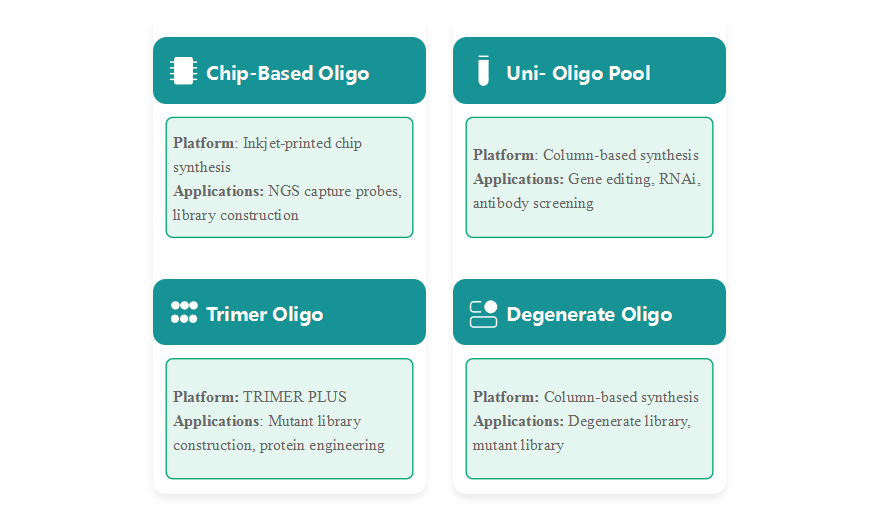
In this guide, we'll compare the four major approaches—Chip-Based Oligo Pools, Column-Synthesized Uni-Oligo Pools, Trimer Oligos, and Degenerate Oligos—and explain where each technology performs best.
Two Oligo Synthesis Platforms
1. Chip-Based Oligo Pools
Chip-based synthesis uses high-density microarrays to synthesize thousands to millions of oligonucleotides in parallel directly on a silicon substrate. Each feature on the array independently extends a unique sequence, enabling extremely large libraries in a single synthesis run.
Key Advantages
* Extremely high throughput
* Supports hundreds of thousands to millions of unique sequences
* Lowest cost per sequence for large-scale libraries
Quality Considerations
Because all oligos are recovered together as a pooled product, individual sequences are not purified or quantified separately. Typical synthesis error rates are approximately 1 error per 2,000–3,000 bases. In addition, synthesis efficiency can vary across different regions of the array, introducing representation bias.
Cost Profile
Chip synthesis has a largely fixed manufacturing cost. As library complexity increases, the cost per sequence decreases dramatically, making it the preferred solution for genome-scale projects.
2. Column-Synthesized Uni-Oligo Pools
Column synthesis follows the traditional controlled pore glass (CPG) phosphoramidite chemistry. Each oligonucleotide is synthesized in an individual column, allowing every sequence to be independently monitored and quality controlled before pooling.
After synthesis, each oligo is quantified individually (typically by OD measurement) and combined at defined molar ratios to create the final pool.
Key Advantages
* Individual synthesis traceability
* Higher sequence purity
* Excellent pool uniformity
* Minimal risk of sequence dropout
Quality Considerations
Optional purification methods such as DSL or PAGE Plus further improve product quality. Since each oligo is quantified before pooling, representation is significantly more uniform than chip-based synthesis, making these pools ideal for quantitative downstream studies.
Cost Profile
Unlike chip synthesis, costs scale with both **the number of oligos and the requested yield**. Higher production amounts require more synthesis reagents and purification, resulting in higher overall costs.
Two Library Design Strategies
While chip and column synthesis describe manufacturing methods, Trimer and degenerate oligos describe how sequence diversity is encoded during library design.
1. Trimer Oligos
Trimer synthesis builds oligonucleotides using preassembled trinucleotide phosphoramidites, allowing mutations to be introduced directly at the codon level rather than nucleotide by nucleotide.
At Synbio Technologies, Trimer synthesis supports up to 20 trimer insertion sites within a single oligo, enabling highly diverse yet precisely controlled protein engineering libraries.
Advantages
* Eliminates redundant codons
* Completely avoids stop codons
* Highly uniform amino acid representation (average deviation ≤10%)
* Customizable codon usage and amino acid ratios
* Ideal for saturation mutagenesis and protein engineering
Limitations
The specialized chemistry makes Trimer synthesis more expensive and typically requires a longer production timeline than standard degenerate oligos.
2. Degenerate Oligos
Degenerate oligos generate sequence diversity by introducing mixed nucleotide phosphoramidites** during synthesis. Positions may contain mixtures such as N (A/T/G/C) or K (G/T), allowing many sequence variants to arise from random nucleotide combinations.
Advantages
* Simple and economical
* No specialized building blocks required
* Fast turnaround
* Well suited for exploratory library construction
Quality Considerations
Because nucleotide coupling efficiencies are inherently unequal, codon representation is often biased. For example, in an NNK design:
* The 32 possible codons are not represented equally.
* Approximately 3.1% of variants** encode stop codons (1 stop codon out of 32 possible NNK codons), reducing the proportion of functional clones.
* Rare codons may also affect downstream protein expression.
While these limitations are acceptable for many discovery-stage projects, they become increasingly important in applications requiring quantitative comparisons.
Which Oligo Pool Is Right for Your Project?
Scenario 1: Genome-Scale Functional Screening
Typical applications
-
Genome-wide CRISPR knockout libraries
-
CRISPRi/CRISPRa libraries
-
Large ORF libraries
Recommended solution: Chip-Based Oligo Pools
When tens of thousands to millions of sequences are required, chip synthesis provides the only practical balance between throughput and cost. Because representation bias is inevitable, adequate next-generation sequencing (NGS) coverage should be incorporated into the workflow to evaluate library composition.
Scenario 2: Medium-Scale, High-Quality Targeted Libraries
Typical applications
-
Focused kinase libraries
-
Pathway-specific screening
-
Secondary validation libraries
Recommended solution: Column-Synthesized Uni-Oligo Pools
For libraries containing hundreds of sequences, column synthesis offers substantially better uniformity and quantitative accuracy. Individual oligo normalization minimizes representation bias, reducing the need for extensive sequencing-based correction.
Scenario 3: Saturation Mutagenesis for Protein Engineering
Typical applications
-
Enzyme active sites
-
Antibody CDR optimization
-
Protein–protein interaction interfaces
Recommended solution: Trimer Oligos
When every amino acid substitution matters, Trimer synthesis provides the highest level of precision. By eliminating stop codons and maintaining balanced codon representation, it maximizes the diversity of functional variants while minimizing wasted screening capacity.
Scenario 4: Budget-Conscious Discovery Projects
Typical applications
-
Preliminary functional scans
-
Early-stage target exploration
-
Pilot mutagenesis studies
Recommended solution: Degenerate Oligos
Degenerate libraries offer the most economical approach for identifying promising mutation hotspots. Once candidate residues have been identified, researchers can refine those regions using Trimer-based libraries for higher-resolution optimization.
Choosing the Right Technology Starts with Your Experimental Goals
There is no universally "best" oligo pool technology—only the one that best matches your scientific objectives.
Need maximum throughput? Choose Chip-Based Oligo Pools
Need quantitative accuracy? Choose Column-Synthesized Uni-Oligo Pools.
Need precise protein engineering? Choose Trimer Oligos.
Need an economical discovery library? Choose Degenerate Oligos.
Selecting the appropriate platform at the beginning of a project can significantly improve library quality, reduce downstream screening bias, and save both time and resources.
At Synbio Technologies, our comprehensive Oligo Pool portfolio supports applications ranging from genome-scale functional genomics to high-precision protein engineering.
Whether you're designing a CRISPR library, antibody optimization workflow, or directed evolution campaign, our experts can help you select the synthesis strategy that delivers the best balance of throughput, accuracy, and cost for your research.