
 DNA Synthesis
 Vector Selection
 Molecular Biology
 Oligo Synthesis
 RNA Synthesis
 Variant Libraries
 Genome KO Library
 Oligo Pools
 Virus Packaging
 Gene Editing
 Protein Expression
 Antibody Services
 Peptide Services
 DNA Data Storage
 Standard Oligo
 Standard Genome KO Libraries
 Standard Genome Editing Plasmid
 ProXpress
 Protein Products
Synbio Technologies is pleased to announce its contribution to a collaborative study recently published in Nature Neuroscience.
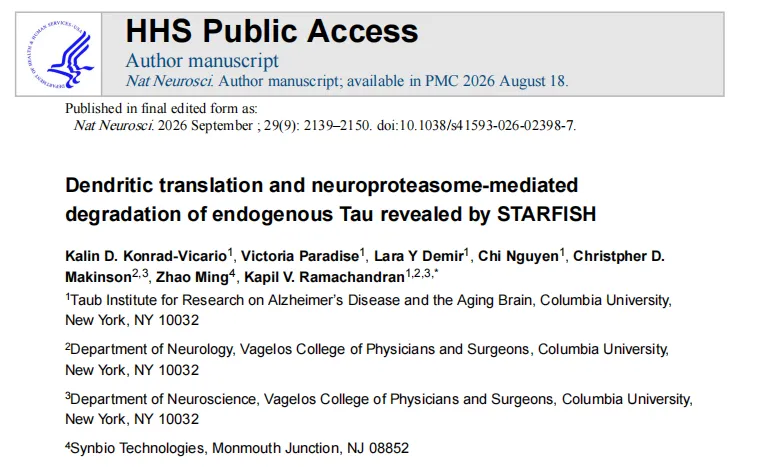
The research, titled “Dendritic translation and neuroproteasome-mediated degradation of endogenous tau revealed by STARFISH,” was published online on August 13, 2026.
Read the full publication: https://doi.org/10.1038/s41593-026-02398-7
Synbio Technologies served as a collaborating partner, contributing to key experimental work including the synthesis of specialized probes used in the STARFISH platform.
Advancing Research into Tau Biology
Tau mislocalization and aggregation are closely associated with the pathology of Alzheimer’s disease (AD). However, understanding where endogenous tau is synthesized and how newly synthesized tau is regulated has remained challenging.
In this study, researchers developed STARFISH (spatially-resolved translation of endogenous RNA FISH) to visualize endogenous mRNA translation with high spatial resolution.
Using STARFISH, the researchers investigated transcripts including Arc, Camk2a, Actb, and Mapt, providing new insights into the spatial dynamics of tau translation and degradation in neurons.
The findings provide evidence that tau can be locally translated in dendrites and that newly synthesized tau can undergo neuroproteasome-mediated degradation, offering a new perspective on tau regulation.
Precision Probe Synthesis for STARFISH
Synbio Technologies supported the study through the synthesis of specialized probes designed for the STARFISH workflow.
Key probe features included:
-
Click-chemistry modifications: Tetrazine (Tz) or Azide handles for downstream conjugation 14-nt semi-flexible linker: Designed to reduce steric hindrance and improve spatial accessibility
-
Controlled probe design: 20–24 bp length, 40–60 bp spacing, 35–50% GC content, and Tm ≤44°C
-
RNase-free synthesis: Supporting compatibility with downstream click chemistry, UnFold probe connection, rolling circle amplification, and immunostaining
These precisely designed probes supported successful STARFISH applications across multiple transcripts and helped enable high-resolution visualization of endogenous translation.
Reliable Click-Chemistry Solutions
In addition to specialized probe synthesis, Synbio Technologies has provided DNA sequence modification and click-chemistry synthesis services since 2019.
Our modification capabilities include: DBCO · BCN · TCO · Tetrazine (Tz) · Azide · Alkyne
These chemistries can support a broad range of biomolecular conjugation applications, with solutions designed for high coupling efficiency, rapid reaction kinetics, flexible reaction conditions, and consistent batch performance.
DBCO–Azide
Under appropriate conditions, DBCO–Azide coupling can achieve >95% coupling efficiency, with typical reaction times of approximately 1–3 hours. The chemistry can be performed under neutral, mildly acidic, or mildly basic conditions and is also compatible with anhydrous environments.
TCO–Tetrazine
TCO–Tetrazine chemistry offers exceptionally rapid reaction kinetics, with coupling achievable within seconds under appropriate conditions. It is particularly suitable for applications where fast conjugation is important.
Supporting Advanced Molecular Research
The publication of this study highlights the importance of precisely designed molecular tools in advancing biomedical research.
From FISH probes and spatial biology to modified oligonucleotides and biomolecular conjugation, Synbio Technologies provides customized synthesis and modification solutions to support complex research workflows.
We are proud to contribute our expertise to collaborative research at the forefront of neuroscience and molecular biology.
Synbio Technologies — Precision Molecular Tools for Advanced Life Science Research.