
 DNA Synthesis
 Vector Selection
 Molecular Biology
 Oligo Synthesis
 RNA Synthesis
 Variant Libraries
 Genome KO Library
 Oligo Pools
 Virus Packaging
 Gene Editing
 Protein Expression
 Antibody Services
 Peptide Services
 DNA Data Storage
 Standard Oligo
 Standard Genome KO Libraries
 Standard Genome Editing Plasmid
 ProXpress
 Protein Products
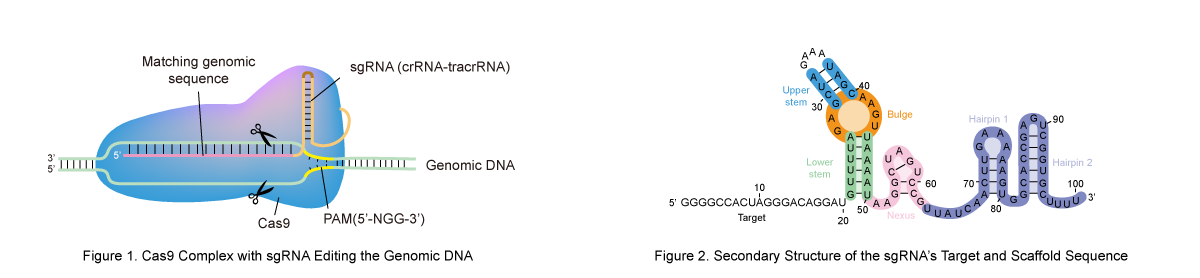
Gene editing has rapidly transformed the research landscape, thanks to the powerful Cas9 system. One key component in this system is the sgRNA (single-guide RNA), which plays a crucial role in guiding the Cas9 enzyme to the target DNA. However, for some gene editing applications, researchers may also use crRNA/tracrRNA complexes. At Synbio Technologies, we understand that choosing the right type of RNA for your project can significantly impact your research outcomes. In this article, we’ll explore the differences between sgRNA and crRNA/tracrRNA, helping you make the best choice for your gene editing experiments.
Understanding sgRNA and Its Role in Gene Editing
When it comes to gene editing, synthetic sgRNA is often the go-to choice for researchers. This molecule is a fusion of crRNA and tracrRNA, designed to work seamlessly with the Cas9 enzyme. Unlike crRNA/tracrRNA pairs, synthetic sgRNA is ready to use immediately without the need for further processing or annealing. It provides a high level of stability, precision, and efficiency in gene editing. At Synbio Technologies, our synthetic sgRNA and crRNA service includes both chemical synthesis and in vitro transcription options, allowing us to deliver the perfect sgRNA sequence tailored to your needs.
Why CrRNA/TracrRNA Might Be Suitable for Your Research
CrRNA and tracrRNA, when combined, form the traditional guide RNA complex that directs the Cas9 enzyme for gene editing. This method requires the two RNA molecules to be separately synthesized, which can be time-consuming and requires precise modifications to achieve the best results. However, this system offers certain advantages in specific applications, especially when working with multiple target sites. By splitting the functions of crRNA and tracrRNA, this system can sometimes offer greater flexibility in complex gene editing tasks. At Synbio Technologies, we offer high-quality synthetic crRNA and tracrRNA products, ensuring that researchers can use this versatile system when required.
Choosing Between sgRNA and crRNA/tracrRNA
So, how do you choose between synthetic sgRNA and crRNA/tracrRNA for your gene editing project? The decision depends largely on the complexity of your experiment and your specific goals. If you need a quick, reliable, and easy-to-use solution for gene editing, synthetic sgRNA is likely the best choice. For more complex projects that require customizations at multiple target sites, crRNA/tracrRNA might offer the flexibility needed. At Synbio Technologies, we are happy to help you decide the best option by offering both services, ensuring that your gene editing is as effective and efficient as possible.
Conclusion
In summary, both synthetic sgRNA and crRNA/tracrRNA have their unique advantages depending on your gene editing needs. If you're looking for a ready-to-use, stable, and efficient RNA for genome editing, synthetic sgRNA is an excellent option. However, if you require flexibility for working with multiple target sites or other specialized applications, the crRNA/tracrRNA system might be better suited to your project. At Synbio Technologies, we are committed to providing high-quality, customizable synthetic sgRNA and crRNA services that will help propel your research forward with accuracy and reliability. Whether you need quick synthesis or custom modifications, we have the expertise and products to support your gene editing endeavors.