
 DNA Synthesis
 Vector Selection
 Molecular Biology
 Oligo Synthesis
 RNA Synthesis
 Variant Libraries
 Genome KO Library
 Oligo Pools
 Virus Packaging
 Gene Editing
 Protein Expression
 Antibody Services
 Peptide Services
 DNA Data Storage
 Standard Oligo
 Standard Genome KO Libraries
 Standard Genome Editing Plasmid
 ProXpress
 Protein Products
In recent years, genetic medicine has entered an unprecedented growth phase. The approval of nucleic acid drugs and the development of CRISPR-based gene editing therapies have opened newpaths for treating diseases that were previously considered incurable.
However, the terminology around RNA therapy vs gene therapy is often used interchangeably by the public and even some healthcare professionals. While both approaches involve manipulating genetic information, they differ fundamentally in their mechanisms, duration, and clinical applications.
Read on for more about RNA therapy vs gene therapy.
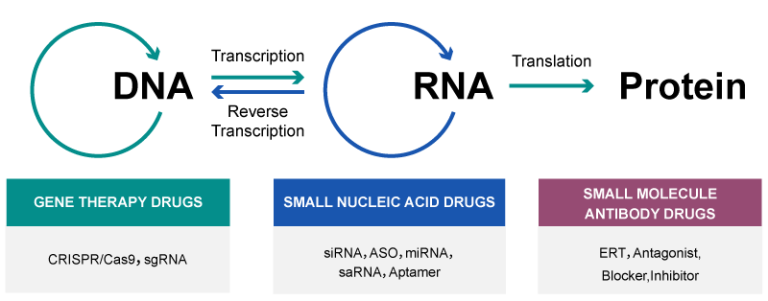
What is Gene Therapy?
The National Institutes of Health defines gene therapy as "an approach that treats genetic disorders by providing new DNA to certain cells or correcting the DNA," typically achieved by introducing a functional copy of a gene or replacing a defective gene with a healthy one.[1]
1. Mechanism
Gene therapy works by introducing, changing, or removing genetic material within a person’s cells. This typically involves:
-
Replacing a mutated gene that causes disease with a healthy copy.
-
Inactivating ("knocking out") a mutated gene that is functioning improperly.
-
Introducing a new gene into the body to help fight a disease.
2. Key Technologies: Viral Vectors and CRISPR
The delivery of these genes requires sophisticated vehicles. Viral vectors, such as Adeno-associated viruses (AAV) or Lentiviruses (LV), are commonly used because they are naturally efficient at entering cells. Once inside, the therapeutic DNA often travels to the patient’s genome.
In more recent years, CRISPR/Cas9 gene editing has revolutionized this sector. It enables precise editing of the genome. By cutting DNA at specific locations, CRISPR allows the correction of mutations or insertion of therapeutic genes.
Because these changes occur at the DNA level, gene therapy is often designed to be a "one-and-done" treatment, offering potentially permanent cures for hereditary conditions.
What is RNA Therapy?
What is RNA therapy exactly? RNA therapy refers to the use of RNA-based molecules to treat or prevent diseases by modulating gene expression without ever altering the underlying DNA sequence. This is a crucial distinction in the RNA therapy vs gene therapy comparison.
Diverse Types of RNA-Based Therapies
The versatility of RNA allows for several therapeutic strategies:
-
mRNA: Used to provide instructions for the cell to produce a specific protein (e.g., the spike protein in COVID-19 vaccines).
-
RNA Interference (RNAi):Including siRNA (small interfering RNA) or microRNA, which degrade or block the translation of target mRNAs to "silence" a problematic gene.
-
Antisense Oligonucleotides (ASOs): Short, synthetic strands of nucleotides that bind to mRNA to alter splicing or trigger degradation.
-
saRNA (Small Activating RNA):Designed to increase the expression of specific genes.
-
Aptamers: RNA molecules that fold into 3D structures to bind to specific protein targets, much like antibodies.
Unlike DNA-based approaches, RNA-based therapies primarily function in the cytoplasm of the cell. They do not need to enter the nucleus to be effective, which simplifies the delivery process and eliminates the risk of permanent genomic integration.
RNA Therapy vs Gene Therapy
To clarify the differences, the following table highlights the technical and clinical distinctions between these two modalities.
|
Feature |
Gene Therapy |
RNA Therapy |
|---|---|---|
|
Target Molecule |
DNA |
RNA |
|
Mechanism |
Correction, Replacement, or Editing |
Translation modulation or RNA degradation |
|
Action Location |
Cell Nucleus (typically) |
Cell Cytoplasm |
|
Genome Impact |
Permanent / Potentially Heritable |
Transient / Non-integrating |
|
Duration of Effect |
Months to lifetime |
Hours to weeks |
|
Delivery System |
Viral vectors, CRISPR, plasmids |
Lipid Nanoparticles (LNPs), Chemical Conjugates |
|
Safety Risk |
Insertion mutagenesis, off-target editing |
Transient immune response |
|
Dosing |
Single dose (One-and-done) |
Repeat dosing required |
|
Typical Drugs |
CRISPR therapies, gene replacement therapy |
mRNA vaccines, siRNA drugs, ASO |
|
Applications |
Genetic disorders, inherited diseases |
Vaccines, cancer |
Advantages and Limitations
1. Gene Therapy
The greatest advantage of gene therapy is its durability. For patients with rare monogenic disorders like spinal muscular atrophy (SMA) or certain forms of blindness, a single infusion can provide a lifetime of healthy protein production.
However, this permanence is also its greatest risk. If a "knock-out" occurs at the wrong site (off-target mutation), the damage is permanent.
Furthermore, the use of viral vectors can trigger strong immune responses, often preventing a patient from receiving a second dose if the first fails.
2. RNA Therapy
By contrast, RNA therapies are highly flexible and reversible. Because the effect wears off as the RNA molecules are naturally degraded by the cell, dosing can be adjusted or stopped if side effects occur. This makes RNA ideal for treating chronic diseases.
The rapid development of mRNA COVID-19 vaccines proved that RNA platforms can be scaled and adapted much faster than traditional DNA or protein-based methods.
However, because the effect is temporary, patients generally require repeated administration. This has led to the development of sophisticated delivery systems like Lipid Nanoparticles (LNPs) to protect the fragile RNA and ensure it reaches the target tissue.
Clinical Examples
-
mRNA Vaccines: These represent a specialized form of gene-based vaccines that use the body's own translation machinery to stimulate an immune response.
-
CRISPR Therapy: Exa-cel (Casgevy) is a landmark gene therapy for sickle cell disease that permanently edits the DNA in bone marrow cells.
-
siRNA Drugs: Onpattro (Patisiran) uses RNA interference to "silence" the production of toxic proteins in the liver for patients with hATTR amyloidosis.
Empowering Research with Synbio Technologies
For researchers working on RNA therapy and gene therapy, Synbio Technologies provides comprehensive synthetic biology services. These include:
-
Custom RNA oligo synthesis
-
Long RNA and mRNA synthesis
-
siRNA and miRNA production
-
In vitro transcription for experimental and therapeutic applications, etc.
Synbio Technologies supports the development of RNA therapies, enabling high-quality RNA synthesis for vaccines, gene modulation studies, and preclinical research. Our platform ensures reliable production, quality control, and technical support, helping researchers accelerate RNA therapy development.
Contact us for more information about RNAand DNAsynthesis services.
References
[1] What Are Genetic Therapies? Available at: https://www.nhlbi.nih.gov/health/genetic-therapies (Accessed: 31 March 2026)