
 DNA Synthesis
 Vector Selection
 Molecular Biology
 Oligo Synthesis
 RNA Synthesis
 Variant Libraries
 Genome KO Library
 Oligo Pools
 Virus Packaging
 Gene Editing
 Protein Expression
 Antibody Services
 Peptide Services
 DNA Data Storage
 Standard Oligo
 Standard Genome KO Libraries
 Standard Genome Editing Plasmid
 ProXpress
 Protein Products
In the realm of precision molecular biology, the qPCR probe has emerged as a cornerstone technology for sensitive and specific nucleic acid detection.
Unlike non-specific dye methods, probe-based qPCR greatly improves target specificity by generating fluorescence primarily when the probe hybridizes to the intended target sequence, making it a valuable tool in critical diagnostic and research workflows.
From identifying viral pathogens to analyzing complex genetic mutations, the versatility of probe chemistry allows for unparalleled accuracy. This article explores the diverse applications of qPCR probe technology. Read on to learn more.
How Probe-Based qPCR Works?
A qPCR probe is a short, synthetic oligonucleotide designed to bind to a specific region within the amplified target sequence during real-time PCR. These probes carry a fluorescent reporter at the 5' end and a quencher at the 3' end; when intact, the quencher suppresses the fluorescent signal.
During PCR amplification, when the probe hybridizes to its target, it is cleaved by the 5’→3’ exonuclease activity of Taq DNA polymerase during strand extension. The fluorescent dye is then released, producing a signal that correlates with the amount of target sequence present. This mechanism makes probe-based qPCR both quantitative and highly specific.
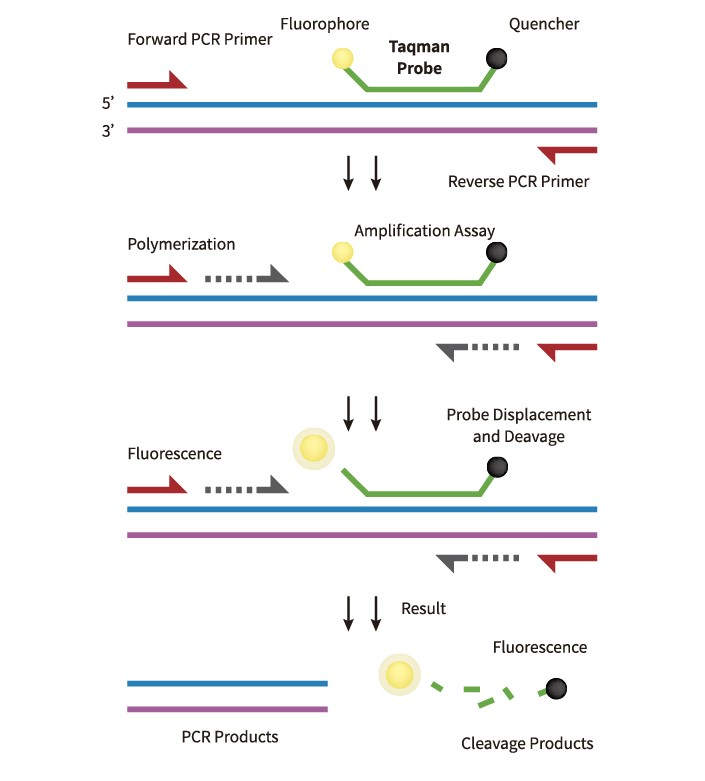
Several types of probe chemistry exist to enhance this process:
-
TaqMan Probes: Dual-labeled probes with a fluorescent reporter and a quencher that generate fluorescence upon hydrolysis.
-
LNA (Locked Nucleic Acid) Probes: Feature modified nucleotides to increase stability and affinity.
-
MGB (Minor Groove Binder) Probes: Increase the melting temperature (Tm), allowing for shorter, and more specific designs.
-
Molecular Beacons & Scorpion Probes: Structured probes designed with hairpin or unimolecular configurations that enable rapid and highly specific signal generation.
Unlike the dye method, which intercalates with any double-stranded DNA and reports overall amplification, qPCR probes offer target-specific fluorescence that reduces non-specific signals and false positives, making them more reliable for precise quantification.
Medical & Clinical Diagnostics
In medicine, diagnostic errors have direct consequences. Probe-based qPCR remains one of the most widely adopted and trusted methods in clinical molecular diagnostics due to its high specificity and sensitivity.
-
Viral Detection: It is used for detecting respiratory viruses (like Influenza or SARS-CoV-2) and blood-borne pathogens (HIV, Hepatitis B/C), where early detection of low viral loads is life-saving.
-
Bacterial & Resistance Testing: Laboratories utilize probe-based qPCR to identify bacteria and detect antibiotic resistance genes, such as mecA or vanA, directly from patient samples.
-
Oncology: Precision medicine relies on qPCR probe design to identify tumor markers and specific genetic mutations (e.g.,EGFR orKRAS), facilitating targeted cancer therapies.
The dual-specificity of primers plus probe ensures that primer dimers do not create false positive results. Moreover, by using different fluorescent dyes, clinicians can detect multiple pathogens or mutations in a single reaction tube, saving time and sample volume.
Infectious Disease Surveillance
Public health authorities rely on qPCR probe technology for large-scale epidemiological monitoring. The high sensitivity of this method is crucial for identifying "low-copy" pathogens in individuals who may be asymptomatic but are still capable of spreading disease.
By implementing a robust probe-based qPCR strategy, healthcare systems can track the movement of infectious agents through populations in real-time, enabling faster intervention and containment.
Environmental Testing
The application of qPCR probe technology extends far beyond the clinic into our natural surroundings.
-
Water Quality: It is used to detect genetic markers of pathogenic microorganisms in drinking water and wastewater, including organisms such asLegionella, Cryptosporidium, or E. coli.
-
Soil Analysis: Researchers study microbial community structures to assess soil health and agricultural viability.
-
Harmful Algal Blooms: Monitoring toxic algae in water bodies helps protect both local ecosystems and consumers.
In these contexts, the primary advantage of probe chemistry is its ability to maintain extreme specificity even when the sample is "dirty" or contains a complex mixture of non-target organic matter.
Food Safety Applications
The food industry utilizes the qPCR probe to ensure products are safe for consumption and accurately labeled.
-
Foodborne Pathogen Detection: Rapidly identifying Salmonella, Listeria, or Campylobacterin the production chain prevents contaminated products.
-
Allergen Identification: Precise qPCR probe design can detect trace DNA from allergen sources such as peanuts or wheat, which is often used as a molecular proxy for gluten-containing ingredients.
In large-scale industrial testing, the stability and reproducibility of probe-based qPCR ensure consistent results across thousands of daily samples.
Agriculture & Veterinary Use
In the agricultural sector, qPCR probe technology is a vital tool for biosecurity and productivity.
-
Plant Pathogens: Plant diseases caused by fungi, bacteria, or viruses can devastate crops. Probe-based qPCR assays allow early detection of pathogens like Phytophthora or Rhizoctonia, enabling researchers to take targeted action to protect yields.
-
GMO Verification: Specific probe chemistry is used to verify the presence of genetically modified traits in seeds and produce.
-
Veterinary Diagnostics: Monitoring livestock for diseases like Swine Fever or Avian Flu ensures the stability of the food supply.
Research Applications
For basic and applied research, the qPCR probe remains the preferred method for quantitative analysis.
-
Gene Expression: Quantifying mRNA levels to understand how genes respond to drugs or environmental changes.
-
Target Quantification: Precise measurement of DNA/RNA copy numbers, including viral load measurement, gene copy number variations, and microbial load quantification.
Probe-based qPCR enables highly accurate quantitative analysis and can support absolute quantification when used with appropriate standards or calibration curves. Its sequence-specific design is especially useful for distinguishing closely related sequences, such as single nucleotide polymorphisms (SNPs), where dye-based methods lack sufficient specificity.
Premium qPCR Probe Synthesis by Synbio Technologies
For researchers and diagnostic developers seeking high-quality qPCR probe solutions, Synbio Technologies offers comprehensive diagnostic probes & oligos services designed to support probe-based qPCR assays across applications. We offer:
-
High Purity and Customization: Probes with up to 98% purity and customizable fluorescent labels and quenchers tailored to assay needs.
-
Diverse Probe Types: Including TaqMan, MGB, molecular beacons, Scorpion-shaped, LNA, dual-quencher probes, etc., enabling flexible assay formats.
-
Quality Assurance: Manufactured under ISO 9001 and ISO 13485 certified quality management systems to ensure batch-to-batch consistency and reliable probe performance.
Whether developing clinical diagnostics, environmental assays, or agricultural pathogen tests, Synbio Technologies’ qPCR probe services support robust and reproducible results.
Conclusion
The qPCR probe is an essential tool in modern science, offering the specificity and sensitivity required for complex molecular detection. From clinical diagnostics to food safety, the right qPCR probe design and high-quality probe chemistry are vital.
For reliable, high-performance results, contact Synbio Technologies for all your professional probe-based qPCR synthesis and development needs.