
 DNA Synthesis
 Vector Selection
 Molecular Biology
 Oligo Synthesis
 RNA Synthesis
 Variant Libraries
 Genome KO Library
 Oligo Pools
 Virus Packaging
 Gene Editing
 Protein Expression
 Antibody Services
 Peptide Services
 DNA Data Storage
 Standard Oligo
 Standard Genome KO Libraries
 Standard Genome Editing Plasmid
 ProXpress
 Protein Products
Antibody humanization is an important step in advancing non-human antibody candidates toward therapeutic development. By replacing or modifying non-human antibody sequences while preserving target-binding activity, humanization can help reduce immunogenicity and improve the developability of antibody candidates for downstream preclinical research.
For academic life sciences researchers and biotech R&D teams, selecting the right humanization strategy is essential for maintaining antibody affinity and specificity while optimizing properties such as sequence compatibility, stability, expression, and solubility.
Synbio Technologies provides integrated antibody humanization services that combine computational antibody design, phage/yeast display, antibody engineering, affinity screening, and characterization to support antibody candidates from early discovery through preclinical development.
Why Is Antibody Humanization Important?
Monoclonal antibodies derived from non-human species can potentially trigger unwanted immune responses when administered to humans. Murine antibodies, for example, may induce human anti-mouse antibody (HAMA) responses, which can affect their suitability for therapeutic applications.
Antibody humanization aims to reduce the amount of non-human sequence while retaining the structural features responsible for antigen recognition.
A successful humanization strategy should therefore achieve more than a high percentage of human sequence. It should also preserve or improve:
• Antigen-binding affinity
• Target specificity
• Protein stability
• Solubility
• Expression
• Aggregation resistance
• Overall developability
This balance is particularly important during preclinical research, when antibody candidates are evaluated for their suitability for further development.
Major Antibody Humanization Approaches
The appropriate humanization strategy depends on the parental antibody, antigen, available structural information, and desired development objectives. Common approaches include chimerization, CDR grafting, resurfacing, and SDR grafting.
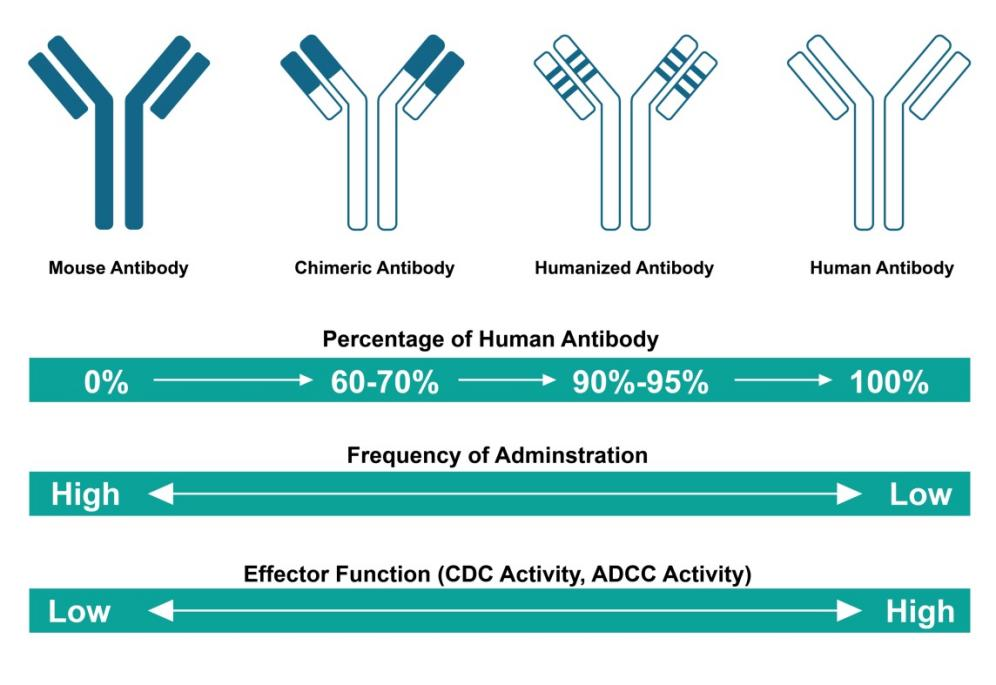
Comparison of Four Types of Monoclonal Antibodies
• Chimeric Antibody Construction
Chimeric antibodies combine the variable regions of a non-human antibody with human constant regions.
Because the variable regions retain the original antigen-binding sequences, chimerization can help preserve the affinity and specificity of the parental antibody while reducing the overall proportion of non-human sequence.
However, the entire variable region remains non-human, meaning that further humanization may be necessary for therapeutic antibody development.
Chimeric antibody construction can therefore serve as an intermediate step in antibody engineering and antibody humanization workflows.
• CDR Grafting
CDR grafting is one of the most widely used approaches for generating humanized antibodies.
The antibody variable region contains three complementarity-determining regions (CDRs) supported by four framework regions (FRs). Because CDRs play a major role in antigen recognition, the CDRs from a non-human antibody can be grafted onto selected human antibody frameworks.
This approach can substantially reduce non-human sequence while maintaining antigen-binding activity.
However, framework residues can influence CDR conformation and antigen recognition. As a result, straightforward CDR grafting may sometimes lead to reduced affinity or altered specificity.
Additional framework optimization and experimental screening can therefore be required to identify humanized variants with suitable functional properties.
• Resurfacing
Resurfacing focuses on modifying selected solvent-exposed amino acid residues in non-human antibody framework regions.
Rather than extensively replacing the framework, researchers modify surface residues to make the antibody more similar to human antibodies while attempting to preserve the structural characteristics of the parental antibody.
This approach can be useful when maintaining the original antibody structure is important for preserving binding activity.
• SDR Grafting
Specificity-determining region (SDR) grafting takes a more targeted approach to antibody humanization.
Not every residue within a CDR contributes equally to antigen recognition. SDR grafting identifies the residues that are most important for antibody-antigen interactions and transfers these regions onto suitable human antibody frameworks.
SDRs can be identified using antibody-antigen structural analysis, computational modeling, or mutational studies.
By minimizing the amount of non-human sequence retained in the final antibody, SDR grafting provides another strategy for immunogenicity reduction while maintaining target specificity.
Human Antibody Discovery and Engineering
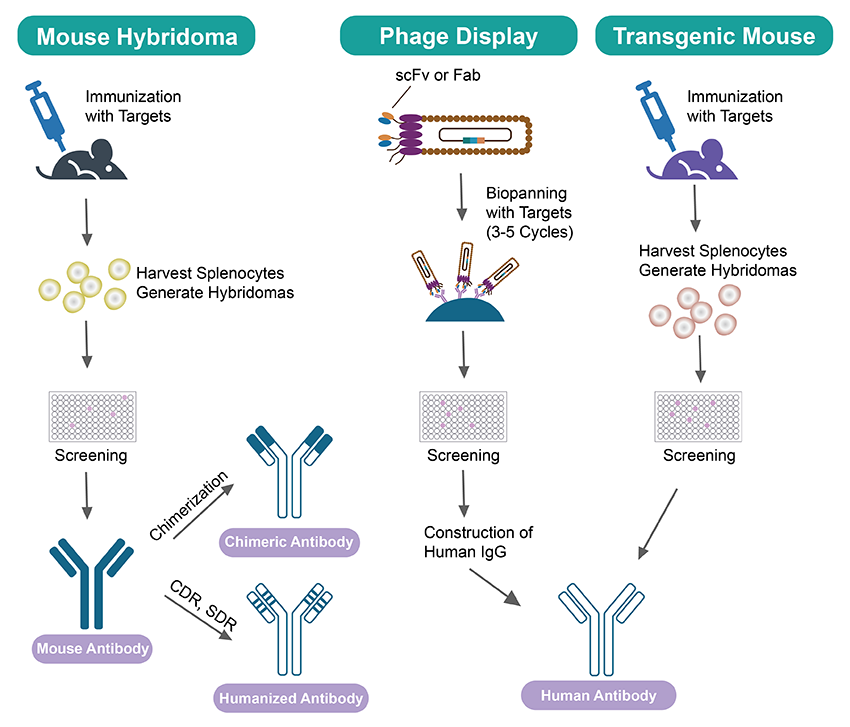
Humanization is not the only route to obtaining antibodies with human sequence characteristics. Fully human antibody discovery technologies can also be used to identify candidates for therapeutic development.
Phage-Displayed Antibody Libraries
Phage display enables researchers to screen large antibody libraries against a target antigen and identify antibody candidates based on their binding properties.
Human antibody variable-region libraries can be screened through iterative selection and enrichment, providing a powerful approach for antibody discovery without requiring traditional hybridoma generation.
Phage display can also be integrated with antibody humanization and affinity maturation workflows, making it particularly useful for antibody engineering and preclinical antibody research.
Transgenic Mouse Technology
Transgenic mouse platforms use genetically engineered animals carrying human immunoglobulin genes.
Following immunization, these mice can generate antibodies with human antibody sequence characteristics. Candidate antibodies can then be isolated, characterized, and further optimized.
This approach provides another route for generating antibody candidates suitable for downstream preclinical development.
From Humanization to Antibody Developability
Humanization is closely connected to antibody developability.
A candidate with a highly human sequence is not necessarily an optimal therapeutic candidate if humanization negatively affects affinity, stability, expression, or aggregation behavior. For this reason, modern antibody humanization services increasingly combine sequence analysis with structural modeling and experimental screening.
A typical workflow may include:
Parental antibody → Sequence analysis → Humanization design → Variant construction → Display-based screening → Binding analysis → Developability assessment → Candidate selection
This integrated approach allows researchers to evaluate multiple humanized variants and identify candidates that balance reduced immunogenicity with functional performance.
For academic laboratories, this can help streamline antibody projects before entering more resource-intensive preclinical studies. For biotech R&D teams, it can provide a systematic workflow for advancing antibody candidates toward further development.
Synbio Technologies Antibody Humanization Services
Synbio Technologies provides integrated antibody humanization services designed to support researchers developing antibody candidates for preclinical research and therapeutic applications.
Our platform combines:
✔ Computational antibody modeling and simulation
✔ Humanization design
✔ Phage and yeast display technologies
✔ Antibody library construction
✔ High-throughput screening
✔ Antigen-antibody binding analysis
✔ Affinity evaluation
✔ Humanized antibody characterization
✔ Antibody production
The platform can support antibody humanization projects involving antibodies from multiple species, including mouse, rat, rabbit, camel, bird, and other non-human sources.
By integrating design, screening, and experimental validation, the workflow is designed to help researchers identify humanized antibody variants that retain the functional characteristics of the parental antibody while improving their suitability for downstream development.
Supporting Preclinical Antibody Research
Antibody humanization is an important component of the transition from antibody discovery to preclinical development. The objective is not simply to increase the proportion of human sequence, but to develop candidates with an appropriate balance of immunogenicity reduction, binding performance, stability, and developability.
For academic life sciences researchers and biotech R&D teams, integrated antibody humanization services can help streamline this process by connecting computational design, antibody engineering, library screening, affinity evaluation, and production.
Synbio Technologies supports researchers with an integrated antibody humanization and affinity maturation platform designed to help advance antibody candidates toward preclinical research and therapeutic antibody development.
Have an antibody candidate that requires humanization? Contact Synbio Technologies to discuss your sequence, target, and project requirements.