
 DNA Synthesis
 Vector Selection
 Molecular Biology
 Oligo Synthesis
 RNA Synthesis
 Variant Libraries
 Genome KO Library
 Oligo Pools
 Virus Packaging
 Gene Editing
 Protein Expression
 Antibody Services
 Peptide Services
 DNA Data Storage
 Standard Oligo
 Standard Genome KO Libraries
 Standard Genome Editing Plasmid
 ProXpress
 Protein Products
Overcoming the inherent biochemical hurdles associated with high GC content is a frequent necessity for researchers working in synthetic biology. At Synbio Technologies, we recognize that sequences containing a high percentage of guanine and cytosine often form stable secondary structures, such as hairpins and loops, which can stall polymerases during the assembly process. These structural complexities frequently lead to truncated products orsignificantly reduce synthesis efficiency in traditional DNA Fragment Synthesis workflows. By applying specialized thermodynamic modeling and proprietary buffer systems, wehelp enable the synthesis of challenging templates with high fidelity. This technical precision allows us to provide reliable genetic material for diverse applications, ranging from metabolic engineering to the construction of complex Gene Fragment Libraries. Our mission is to provide the raw genetic components necessary for High-efficiency Cloning, ensuring that your downstream experiments proceed without the frustration of repeated synthesis attempts.
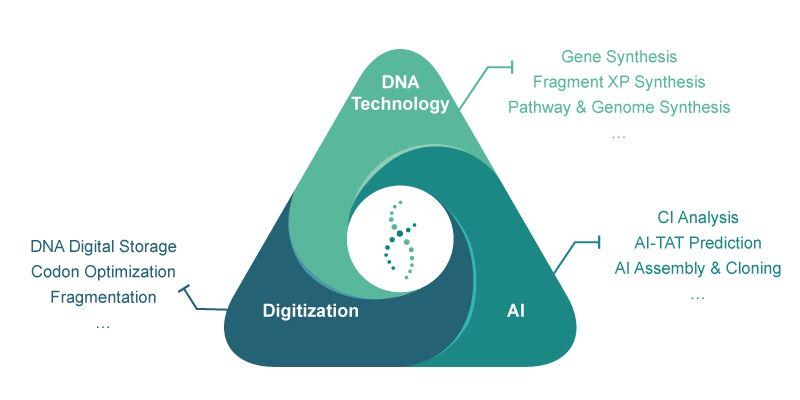
Overcoming Thermodynamic Barriers in DNA Fragment Synthesis
Thermal stability in double-stranded DNA is directly proportional to the number of GC pairs, which possess three hydrogen bonds compared to the two found in AT pairs. When we perform DNA Fragment Synthesis on these regions, the high melting temperature required to denature the strands can often damage the DNA or inhibit the enzymes used in the assembly. To mitigate this, we utilize advanced polymerase variants and additives that lower the melting temperature without compromising the specificity of the base pairing. This meticulous approach to DNA Fragment Synthesis is what enables us to deliver linear double-stranded fragments that are ready for immediate use. Furthermore, by maintaining strict quality control over every DNA Fragment Synthesis project, we guarantee that the final sequence matches your digital design exactly, regardless of how many repetitive elements or GC clusters are present in the original blueprint.
Diversifying Research Assets with Gene Fragment Libraries
Creating a wide array of genetic variants is essential for protein engineering and directed evolution, yet many researchers struggle when these variants include difficult-to-synthesize motifs. We assist scientists by building comprehensive Gene Fragment Libraries that maintain high complexity and uniformity across the entire population of sequences. When constructing these Gene Fragment Libraries, we apply the same rigorous synthesis standards used for individual fragments to ensure that no single variant is under-represented due to its secondary structure. These Gene Fragment Libraries serve as a powerful resource for high-throughput screening, allowing for the rapid identification of functional mutants. By removing the bias often introduced by "unsynthesizable" GC-rich regions, our Gene Fragment Libraries provide a more accurate and complete representation of the sequence space you wish to investigate in your laboratory.
Streamlining Workflows through High-efficiency Cloning Techniques
The ultimate utility of a synthetic fragment lies in its ability to be integrated into a functional vector or genome. We have developed protocols for High-efficiency Cloning that bypass the common pitfalls of ligation-independent assembly and traditional restriction enzyme methods. Because GC-rich fragments can misprime or self-anneal during the circularization step, our High-efficiency Cloning strategy involves optimizing the terminal overlap regions to favor the desired recombination event. This focus on High-efficiency Cloning means that users spend less time screening colonies and more time analyzing their experimental results. By providing a seamless transition from synthesis to sequence-verified plasmid, our High-efficiency Cloning services reduce the total turnaround time for complex projects. We prioritize the stability of the final construct,reducing the risk of plasmid instability associated with high GC content or loss of the insert during bacterial propagation.
The technical expertise required to manage extreme genetic sequences is a hallmark of our service at Synbio Technologies. We understand that the success of your project depends on the quality of the starting material, which is why we refine our DNA Fragment Synthesis methods to handle the most demanding templates. Whether you are looking to build vast Gene Fragment Libraries for screening or require a single, difficult construct for High-efficiency Cloning, our team provides the specialized support necessary for these ambitious goals. Our dedication to accuracy and reliabilityensures high sequence accuracy at the nucleotide level, providing a solid foundation for your continued innovation in the life sciences. By choosing to work with Synbio Technologies, you gain a partner capable of translating digital information into physical reality, no matter the complexity of the genetic code.