
 DNA Synthesis
 Vector Selection
 Molecular Biology
 Oligo Synthesis
 RNA Synthesis
 Variant Libraries
 Genome KO Library
 Oligo Pools
 Virus Packaging
 Gene Editing
 Protein Expression
 Antibody Services
 Peptide Services
 DNA Data Storage
 Standard Oligo
 Standard Genome KO Libraries
 Standard Genome Editing Plasmid
 ProXpress
 Protein Products
Metabolomics helps reveal the functional consequences of genetic modification after a genetic change. While DNA synthesis creates or modifies a sequence, metabolite analysis reveals whether that sequence produces the expected functional outcome. By combining artificial gene synthesis with targeted or untargeted metabolic profiling, researchers can identify pathway bottlenecks, verify engineered phenotypes, and make better decisions during strain optimization. This connection makes metabolomics a valuable part of modern synthetic biology.
What Is Metabolomics?
Metabolomics is the systematic analysis of small molecules produced or consumed by cells, tissues, microorganisms, plants, or other biological systems. These small molecules include amino acids, organic acids, sugars, lipids, nucleotides, and pathway intermediates.
Because metabolites are closely connected to enzyme activity and cellular conditions, they provide a functional snapshot of a biological system. Genomic information reflects genetic potential, whereas metabolite profiles reflect biochemical activity under specific experimental conditions.
This distinction is particularly useful in synthetic biology. A successfully constructed gene does not automatically mean that a desired pathway will operate efficiently. The expressed enzyme may exhibit low catalytic activity because of improper folding, insufficient cofactors, poor expression, or unfavorable pathway context.
How Are Metabolomics and DNA Synthesis Connected?
To understand the connection, researchers first need a clear DNA synthesis meaning. In synthetic biology, DNA synthesis generally refers to the de novo construction of DNA molecules by assembling chemically synthesized oligonucleotides, rather than isolating DNA directly from a biological source.
We describe laboratory DNA synthesis as assembling chemically synthesized DNA oligonucleotides into longer DNA sequences. Chemically synthesized oligonucleotides can be assembled into longer DNA constructs using PCR-based assembly, enzymatic assembly methods such as Gibson Assembly, or other molecular cloning strategies.
However, constructing DNA is only the “build” stage of a synthetic biology project. After the sequence is introduced into a host, researchers must determine whether it changes the phenotype as intended.
This is where Metabolomics becomes useful. It can reveal:
-
Whether the engineered pathway produces the target metabolite
-
Whether precursor molecules are being consumed
-
Whether unwanted by-products are accumulating
-
Whether the modification affects unrelated metabolic pathways
-
Whether pathway optimization may require changes in gene expression, gene copy number, or additional genetic modifications
In synthetic biology projects, producing the correct DNA sequence must be followed by functional validation. Researchers also need to understand whether the synthesized sequence delivers the required biological function.

How Does a Metabolomics Workflow Support Engineered Strain Development?
A well-planned workflow usually begins with a clearly defined biological question. Researchers should specify the host organism, genetic modification, control group, culture conditions, sampling time, and expected phenotype before collecting samples.
1. Design the Genetic Construct
The first step may involve selecting enzymes, regulatory elements, promoters, or pathway genes. Artificial gene synthesis allows researchers to produce these sequences without relying on an available natural DNA template.
At this stage, DNA synthesis refers to sequence construction rather than functional validation A synthesized gene can be sequence-correct but still perform poorly because of expression level, protein folding, pathway balance, or host-cell limitations.
2. Build and Test the Engineered System
The selected sequences are synthesized, assembled, cloned, and introduced into the chosen host. Researchers then evaluate growth, product titer, expression level, genetic stability, and other relevant phenotypes.
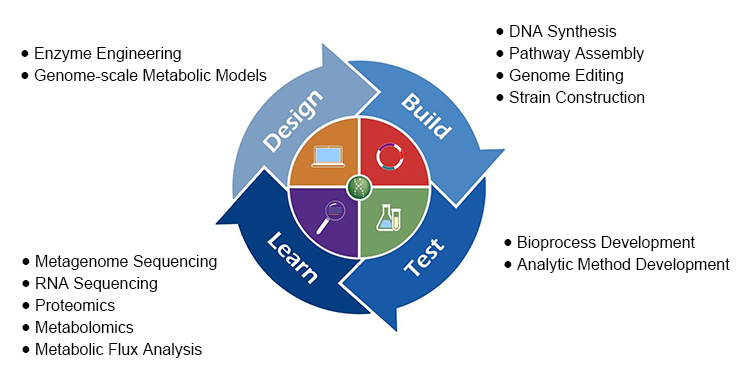
Our broader synthetic biology platform supports Design–Build–Test–Learn activities, including pathway design, DNA synthesis, strain construction, genome editing, enzyme engineering, metabolite analysis, and bioprocess development.
3. Collect Representative Samples
Metabolites can change rapidly in response to temperature, nutrients, oxygen, growth phase, and sample handling. Therefore, the control and experimental groups should be collected under comparable conditions.
Biological replicates, randomized processing, appropriate blanks, and pooled quality-control samples can help researchers distinguish meaningful biological variation from analytical variation. Current untargeted metabolomics guidance emphasizes quality-control samples for monitoring variation introduced during preparation and data acquisition.
4. Identify Differential Metabolites
After data acquisition and processing, researchers compare metabolite profiles between the control and engineered groups. Statistical analysis following normalization and appropriate multiple-testing correction can identify metabolites that differ significantly between groups.
These differences should then be interpreted within biochemical pathways. Individual metabolite changes may provide limited biological insight, whereas coordinated changes across pathways often provide stronger evidence of altered metabolic activity.
5. Redesign the Construct
The findings can guide the next round of DNA synthesis. Researchers may redesign promoters, change enzyme variants, downregulate or knock out genes involved in competing reactions, introduce transporters, or adjust pathway-gene copy numbers.
This feedback loop shows how DNA synthesis, testing, and learning work together in synthetic biology. The sequence is the design input, but metabolite data helps determine the next design decision.
How Can Metabolomics Improve Artificial Gene Synthesis Projects?
Metabolomics does not physically synthesize DNA. Instead, it provides evidence that helps researchers choose which DNA sequences should be built or modified next.
In an artificial gene synthesis project, metabolic data can support several decisions.
First, it can reveal whether the intended product is being formed. An increase in the target metabolite may be consistent with pathway activity, but confirmation may require targeted quantification and additional functional assays.
Second, it can expose precursor limitations. If the target pathway consumes a metabolite faster than the host produces it, another pathway component may need to be engineered.
Third, it can identify competing reactions. Accumulation of an unwanted by-product may indicate that carbon or another substrate is being diverted away from the desired pathway.
Finally, it can reveal cellular stress. A construct may increase product formation while also disrupting cellular energy metabolism, ATP availability, or intracellular redox balance. In that case, the next artificial gene synthesis design may need to balance productivity with host fitness.
What Metabolomics Services Does Synbio Technologies Provide?
We offer a multi-omics platform that integrates untargeted metabolomics, targeted metabolomics, proteomics, and related analytical options. Our services support the identification of differential metabolites, validation of biological targets, and design and optimization of engineered cell factories.
Untargeted services include general untargeted metabolomics, plant metabolomics, untargeted lipidomics, and flavoromics.Our service table lists a turnaround of 20 business days for general untargeted analysis of up to 50 samples. Plant untargeted metabolomics and untargeted lipidomics are listed at 35 business days for up to 50 samples.
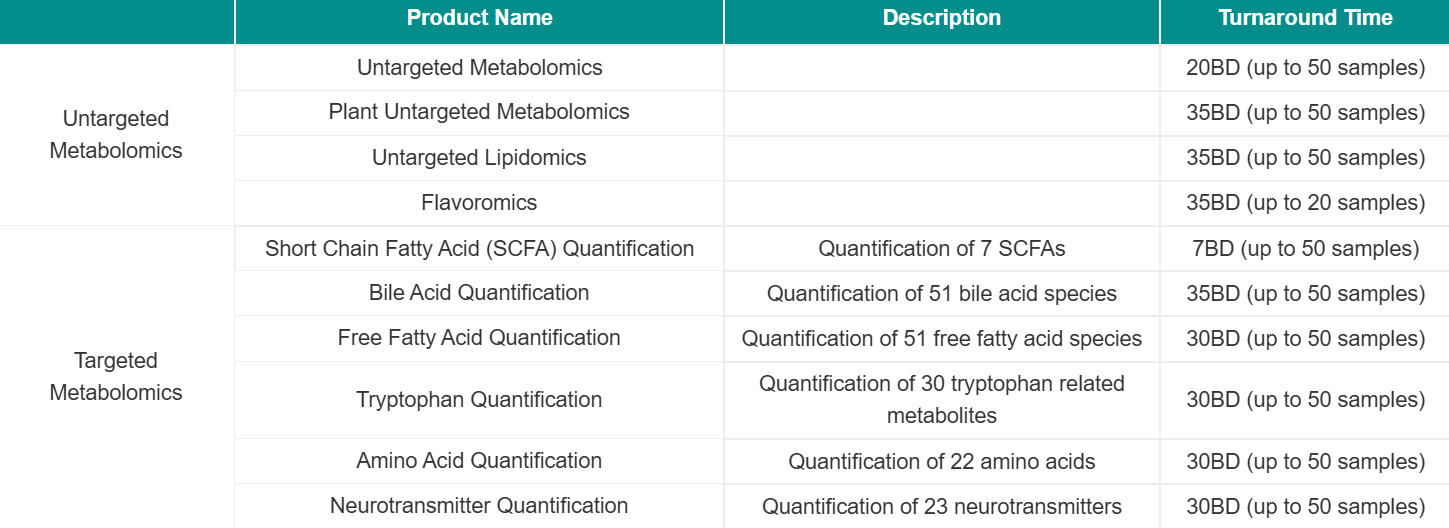
Targeted options listed by Synbio Technologies include quantification panels for:
-
Seven short-chain fatty acids
-
Fifty-one bile acid species
-
Fifty-one free fatty acid species
-
Thirty tryptophan-related metabolites
-
Twenty-two amino acids
-
Twenty-three neurotransmitters
The page also lists customized targeted assays, which require evaluation based on the specific analytes requested.
How Should Researchers Choose the Right Approach?
Untargeted analysis is generally more suitable for broad discovery, unexpected phenotypes, or projects without a predefined metabolite list. Targeted analysis is more appropriate when the compounds and pathways of interest are already known.
A combined strategy is often useful. Researchers can begin with untargeted discovery, select important candidate metabolites, and then apply targeted methods for more focused verification. Synbio Technologies similarly describes a workflow moving from phenotypic screening and global discovery to targeted verification and mechanistic investigation.
Before requesting analysis, researchers should define the sample type, number of groups, biological replicates, expected metabolite classes, collection conditions, and primary research question. These details help determine whether targeted, untargeted, lipidomic, or multi-omics analysis is most appropriate.
Conclusion
Metabolomics connects genetic design with measurable biological function. When combined with DNA synthesis, it helps researchers verify pathways, detect bottlenecks, and improve engineered systems. We support each stage of this iterative engineering cycle through artificial gene synthesis, strain construction, targeted and untargeted metabolomics, and integrated synthetic biology services.