
 DNA Synthesis
 Vector Selection
 Molecular Biology
 Oligo Synthesis
 RNA Synthesis
 Variant Libraries
 Genome KO Library
 Oligo Pools
 Virus Packaging
 Gene Editing
 Protein Expression
 Antibody Services
 Peptide Services
 DNA Data Storage
 Standard Oligo
 Standard Genome KO Libraries
 Standard Genome Editing Plasmid
 ProXpress
 Protein Products
Custom gene synthesis provides the sequence-verified DNA required for circular dsDNA production. The synthesized DNA can then be converted into a circular molecule through plasmid cloning or enzymatic circularization. This is most commonly achieved by ligating the synthesized DNA into a plasmid vector as part of a molecular cloning workflow. Choosing the right method depends on sequence complexity, vector requirements, DNA quantity, purity, and downstream use.
What Is Circular dsDNA?
Covalently closed circular dsDNA contains two continuous DNA strands, with the 5′ and 3′ ends of each strand covalently joined. Unlike linear DNA, it has no exposed ends.
The most common form is a plasmid containing a target gene and a functional backbone. Depending on the application, the backbone may include:
-
An origin of replication
-
A selectable marker
-
A promoter and terminator
-
Regulatory or expression elements
Circular DNA is widely used in cloning, recombinant protein expression, cell transfection, reporter assays, genome editing, and other molecular biology applications.
However, circular dsDNA is not a single standardized format. Researchers must first decide whether they need a conventional plasmid, a compact circular expression cassette, or a bacterial-backbone-free molecule.
How Does Custom Gene Synthesis Create the Linear DNA Input?
Before DNA can be circularized, the requested sequence must be designed, synthesized, assembled, and verified.
Sequence design and evaluation
The process starts with a digital DNA sequence. It may include only a coding sequence or a complete expression cassette containing promoters, untranslated regions, tags, and terminators.
During custom gene synthesis, the sequence is assessed for features that may complicate manufacturing, such as:
-
High or low GC content
-
Repetitive regions
-
Hairpin-forming sequences
-
Long homopolymers
-
Unwanted restriction sites
-
Host-specific codon preferences
We support complex sequence synthesis, including sequences with high or low GC content, repeats, and hairpin structures, and offer codon optimization and vector design options.
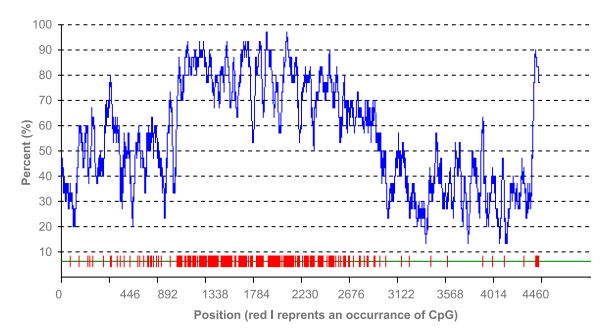
Codon optimization is useful when improving expression in a selected host, but it may be unsuitable when native regulatory sequences or RNA structures must remain unchanged.
Oligonucleotide synthesis and assembly
The target sequence is divided into shorter overlapping oligonucleotides. These chemically synthesized building blocks are then assembled into larger double-stranded DNA molecules using polymerase-, ligase-, or overlap-based methods.
For shorter constructs, gene fragment synthesis can provide the complete linear dsDNA starting material. Synbio Technologies’ Fragment XP service supports sequences from 125 to 3,000 bp, including standard and difficult sequences.
The finished linear fragment can then be cloned into a plasmid or designed for direct enzymatic circularization.
How Is Synthetic DNA Cloned into a Circular Plasmid?
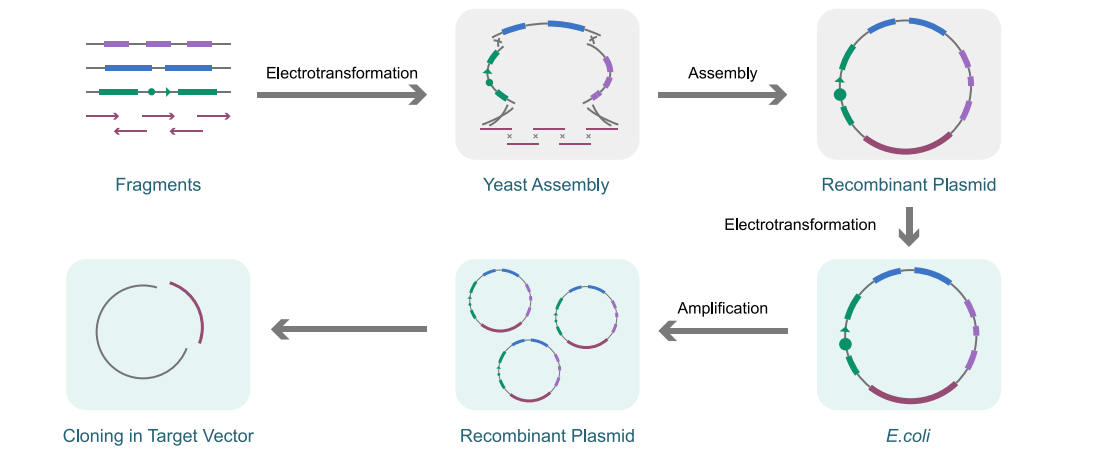
The conventional route combines custom gene synthesis, plasmid construction, bacterial transformation, and plasmid purification.
Step 1: Prepare the insert and vector
The synthetic dsDNA insert and plasmid backbone must contain compatible ends. Restriction enzymes can cut both molecules at selected sites, while overlap-based assembly methods use homologous terminal sequences.
The vector should match the final application. A bacterial cloning plasmid, mammalian expression vector, and microbial production vector will contain different regulatory and replication elements.
Step 2: Join the DNA molecules
DNA ligase seals the phosphodiester backbone between the insert and vector DNA at both junctions. Once both junctions are sealed, a covalently closed circular DNA molecule is formed.
Our cloning workflow can use selected restriction sites to prepare and ligate the target sequence and vector before bacterial transformation. Customers may specify the vector and insertion site.
The initial reaction may contain correct plasmids, empty vectors, linear DNA, nicked circles, or incorrect assemblies. Additional screening is therefore required.
Step 3: Transform bacterial cells
The ligation mixture is introduced into competent bacteria, commonlyEscherichia coli. Cells carrying a plasmid with the appropriate selectable marker are grown under selective conditions.
Individual colonies can then be isolated. Each colony usually represents a separate plasmid clone, allowing researchers to identify the correctly assembled construct.
Step 4: Screen and sequence the construct
Candidate colonies may be evaluated using colony PCR, restriction digestion, and Sanger sequencing.
Sequence verification should cover the synthesized region and both cloning junctions. We verify synthesized sequences by Sanger sequencing before delivery. For PCR cloning or subcloning projects, additional sequencing verification depends on the sequence information provided.
Long or complex constructs may require several sequencing primers to confirm the complete insert.
Step 5: Amplify and purify the plasmid
A verified bacterial clone is expanded in liquid culture. The circular plasmid is then isolated, commonly through alkaline lysis followed by an appropriate purification method.
Purification requirements depend on the application. Important selection factors include:
-
Required DNA quantity
-
DNA concentration
-
Endotoxin expectations
-
Supercoiled DNA content
-
Sensitivity of downstream cells
Can Circular dsDNA Be Produced Without Bacterial Cloning?
Yes. Cell-free methods can directly convert linear dsDNA into circular DNA without bacterial transformation or amplification.
Cell-free circularization can use compatible DNA ends and ligase-mediated joining to convert verified linear dsDNA into a circular molecule. BsaI-HFv2 cuts the DNA to create compatible ends, while T4 DNA ligase joins those ends in the same reaction.
Because Type IIS enzymes cut outside their recognition sequences, the recognition sites can be removed during assembly. T5 exonuclease is then used to digest remaining linear DNA, while closed circular molecules resist digestion because they lack exposed ends.
This approach may be considered when a compact, bacterial-backbone-free circular construct is required.
A simplified cell-free workflow includes:
1. Produce verified linear dsDNA through gene fragment synthesis.
2. Add terminal sequences compatible with Type IIS processing.
3. Perform restriction and ligation in one reaction.
4. Digest unreacted linear molecules.
5. Purify and characterize the circular product.
This method is especially relevant when researchers want a compact expression template without conventional plasmid propagation.
Why Can Enzymatic Circularization Be Highly Efficient?
Traditional DNA cyclization models predict that circularization becomes less favorable at higher DNA concentrations. Under these conditions, separate DNA molecules are more likely to join each other instead of forming individual circles.
Enzymatic circularization efficiency varies with DNA length, sequence flexibility, overhang design, DNA concentration, enzyme ratio, secondary structure, and reaction conditions.
The researchers proposed that the enzyme system increases the effective local concentration of the two DNA ends. Instead of relying only on random molecular movement, enzyme-associated interactions may help hold the ends close enough for ligation.
Which Circularization Route Should Researchers Select?
Conventional plasmid cloning is generally suitable when researchers need:
-
A standard cloning or expression vector
-
A stable bacterial clone
-
Larger quantities of plasmid DNA
-
Established transformation and amplification procedures
-
Long-term plasmid storage
Cell-free circularization may be considered when researchers need:
-
A compact circular expression cassette
-
A bacterial-backbone-free construct
-
Rapid in vitro preparation
-
No bacterial amplification step
-
Direct control over the final circular sequence
Neither approach is suitable for every project. The decision should be based on construct design, intended host, required yield, purity, and functional application.
How Can Synbio Technologies Support Circular dsDNA Production?
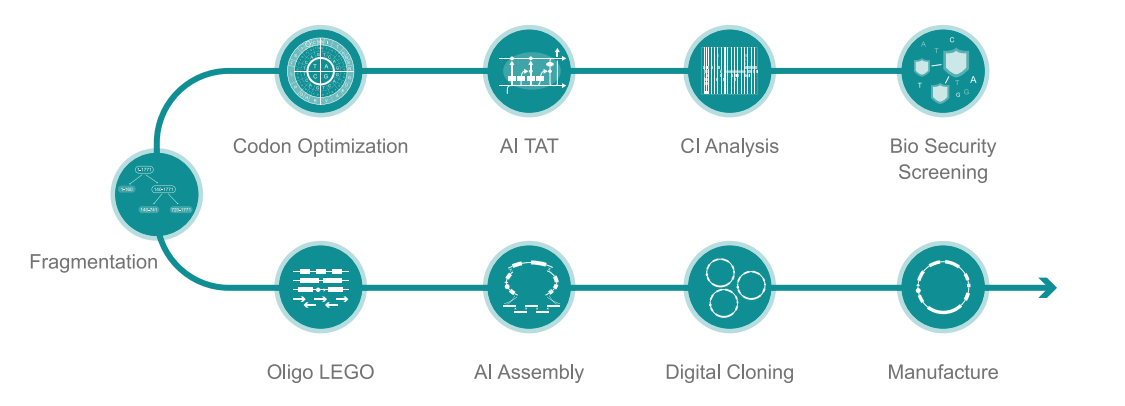
We support circular dsDNA production through gene synthesis, vector construction, cloning, and plasmid preparation services. NG Codon Optimization assists host-oriented design, while the Complexity Index system evaluates difficult features such as unusual GC content, repeats, and hairpins.
The optimized sequence is synthesized as verified linear dsDNA and inserted into a selected plasmid through vector construction, PCR cloning, or subcloning. This cloning step produces circular dsDNA for the intended application.
Deliverables can include lyophilized plasmid DNA, a sequencing chromatogram, and a certificate of analysis. The AI-TAT system also estimates the production cycle to support project planning.
Conclusion
Custom gene synthesis produces circular dsDNA by creating a verified linear sequence and then cloning or enzymatically circularizing it. We support gene synthesis, gene fragment synthesis, vector construction, and cloning, allowing researchers to select a workflow based on their sequence and application requirements.