DNA Synthesis
 Vector Selection
 Molecular Biology
 Oligo Synthesis
 RNA Synthesis
 Variant Libraries
 Genome KO Library
 Oligo Pools
 Virus Packaging
 Gene Editing
 Protein Expression
 Antibody Services
 Peptide Services
 DNA Data Storage
 Standard Oligo
 Standard Genome KO Libraries
 Standard Genome Editing Plasmid
 ProXpress
 Protein Products

Selecting the right recombinant protein expression system requires balancing several critical factors, including post-translational modification (PTM) capabilities, protein yield, production costs, and development timelines.
Each expression platform offers distinct advantages and limitations. The optimal choice depends not only on the target protein's structural and functional requirements but also on the intended application, production scale, and downstream processing needs.
This article explores five major recombinant protein expression systems—E. coli, mammalian cells, insect cells, yeast, and cell-free protein synthesis (CFPS)—highlighting their technical characteristics, limitations, and typical applications to help researchers make informed decisions.
1.Bacterial Expression System: A Cost-Effective Prokaryotic Platform
E. coli is one of the most widely used hosts for recombinant protein production. Its major advantages include well-established genetic engineering tools, rapid cell growth, low cultivation costs, and compatibility with high-density fermentation.
However, as a prokaryotic host,E. coli lacks the machinery required for many complex eukaryotic post-translational modifications, particularly glycosylation. Inclusion body formation is also common during heterologous protein expression, making soluble and functional protein recovery a key challenge.
Successful expression depends on several interconnected factors:
- Target protein characteristics: Molecular weight, disulfide bond requirements, structural complexity, and dependence on molecular chaperones.
- Vector and tag selection: Fusion tags can influence protein solubility, while tag cleavage strategies may affect downstream purification.
- Expression conditions: Temperature, inducer concentration, and induction timing must be optimized to balance expression levels and protein quality.
A mismatch in any of these factors may result in low expression, insoluble products, or reduced biological activity. These outcomes do not necessarily indicate an inherent limitation of the host but may reflect suboptimal expression conditions.
An important consideration: Solubility does not always indicate correct folding.
Proteins with multiple disulfide bonds or complex structural domains may remain soluble while adopting partially folded or incorrect conformations. Therefore, SDS-PAGE alone is insufficient to establish protein quality. Additional structural and functional characterization, such as circular dichroism (CD) spectroscopy and activity assays, may be necessary.
Typical applications:
Industrial enzymes, protein domains, research-grade antigens, and other proteins that do not require complex post-translational modifications.
2. Mammalian Cell Expression: Supporting Native-Like Protein Structure and Function
Mammalian expression systems provide the cellular machinery necessary for complex protein folding and a broad range of post-translational modifications. Their ability to support human-like glycosylation and other processing events makes them particularly valuable for producing proteins that require native-like structural and functional properties.
These characteristics make mammalian cells a preferred platform for therapeutic antibodies, Fc-fusion proteins, glycoproteins, and other biologically complex molecules.
However, mammalian expression also presents several challenges:
Development timelines and process complexity are among the primary considerations. Stable cell line development typically involves transfection, selection, monoclonal isolation, and expression screening, which can be time-consuming. Transient expression offers a faster alternative for early-stage production, although achievable yields vary depending on the target protein, host cell, and process conditions.
Product quality also requires careful evaluation. Glycosylation profiles and batch-to-batch consistency can be influenced by cell line selection, culture conditions, and process parameters. Therefore, successful expression should be assessed not only by yield but also by product quality, structural integrity, and biological activity.
Typical applications:
Therapeutic antibodies, Fc-fusion proteins, complex glycoproteins, viral surface antigens, and other proteins whose biological activity or pharmacokinetic properties depend on appropriate folding and post-translational modifications.
3. Insect Cell–Baculovirus Expression System: Balancing Protein Complexity and Production Efficiency
The insect cell–baculovirus expression vector system (BEVS) is a versatile platform for producing recombinant proteins that require more complex folding and processing than bacterial systems can typically provide.
Common host cell lines include Sf9, Sf21, and High Five cells. Using recombinant baculoviruses as expression vectors, this system supports high-level expression of a wide range of eukaryotic proteins.
One of its major advantages is its ability to accommodate relatively large and structurally complex proteins. Insect cells also support disulfide bond formation and several post-translational modifications, making them particularly useful for producing viral antigens, multiprotein complexes, and structural biology research materials.
Compared with mammalian systems, insect cell expression can offer an attractive balance between production efficiency, cost, and protein complexity.
Key limitations to consider:
Insect cell glycosylation patterns differ from those of mammalian cells. Their glycoproteins generally exhibit simpler, often paucimannose-type N-glycans and typically lack the complex terminal modifications found in mammalian cells, such as extensive terminal sialylation. This may limit their suitability for therapeutic proteins that require specific human-like glycosylation profiles.
Additionally, baculovirus generation, amplification, and infection optimization introduce extra development steps. Cell viability, infection timing, and proteolytic degradation must also be carefully controlled to maintain product quality.
Typical applications:
Viral antigens, virus-like particles (VLPs), multiprotein complexes, structural biology research, and eukaryotic proteins that do not require fully human-like glycosylation.
4. Yeast Expression System: Combining Eukaryotic Processing with Scalable Production
Yeast expression systems, particularly Pichia pastoris (also known as Komagataella phaffii) and Saccharomyces cerevisiae, offer an attractive combination of eukaryotic protein processing, rapid growth, and cost-effective fermentation.
Unlike bacterial systems, yeast can support certain eukaryotic post-translational modifications and efficient secretion of recombinant proteins. This makes yeast particularly valuable when both production efficiency and downstream processing are important considerations.
One of its major strengths is the combination of secretion-based expression and high-density fermentation.
With an appropriate signal peptide, target proteins can be directed into the secretory pathway and released into the culture medium. This reduces the need for cell disruption and can simplify downstream purification. In addition, yeast can be cultivated at high cell densities, supporting scalable production.
For certain proteins, expression titers can reach gram-per-liter levels, although actual yields depend heavily on the target molecule and process optimization.
Key limitations to consider:
Yeast glycosylation differs from mammalian glycosylation. In particular, conventional yeast strains may produce high-mannose-type glycans, which can affect the stability, activity, or pharmacokinetic properties of certain therapeutic proteins.
Secretion efficiency is also protein-dependent. Not all recombinant proteins are efficiently secreted, and some may undergo intracellular retention, proteolytic degradation, or improper folding. Therefore, signal peptide selection and fermentation optimization remain important aspects of process development.
Typical applications:
Industrial enzymes, food-related proteins, vaccine antigens, antibody fragments, and recombinant proteins requiring scalable, cost-efficient production.
5. Cell-Free Protein Synthesis (CFPS): An Alternative for Challenging Protein Targets
Cell-free protein synthesis (CFPS) offers a fundamentally different approach to recombinant protein production. Rather than relying on living cells, CFPS uses extracted cellular transcription and translation machinery to synthesize proteins directly in a controlled reaction environment.
Its greatest value lies in applications where conventional cellular expression systems face significant limitations.
Membrane proteins are a representative example. Their hydrophobic transmembrane regions often make them difficult to express in living cells due to improper folding, aggregation, degradation, or toxicity associated with overexpression.
CFPS provides greater control over the reaction environment and allows researchers to incorporate membrane-mimicking components, such as liposomes, nanodiscs, and detergent micelles. These components can support membrane protein folding and insertion during or after synthesis, depending on the system design.
CFPS also offers flexibility for specialized applications, including the site-specific incorporation of noncanonical amino acids and the use of customized enzymatic components. These approaches can be particularly useful when cellular metabolism or host-cell toxicity limits conventional expression strategies.
Key limitations to consider:
CFPS production titers are generally lower than those achieved through optimized fermentation-based systems, and production costs per unit of protein can be substantially higher. Scaling up for preparative or commercial production therefore remains challenging.
For membrane proteins, successful synthesis does not necessarily guarantee correct membrane insertion, orientation, or topology. These properties must be evaluated using appropriate membrane-mimicking systems and downstream characterization methods.
Typical applications:
Membrane proteins, toxic proteins, difficult-to-express targets, high-throughput expression screening, noncanonical amino acid incorporation, and rapid protein engineering workflows.
6. How to Choose the Right Expression System
No single expression platform is suitable for every recombinant protein. The selection process should begin with the target molecule's structural and functional requirements, followed by an evaluation of production objectives, scalability, and cost.
Beyond these general guidelines, several questions can help narrow down the options:
1. Does the target protein require specific post-translational modifications?
If human-like glycosylation or other complex modifications are essential, mammalian cells are generally the preferred starting point. Insect cells and yeast may be suitable alternatives depending on the required modification profile.
2. Is protein solubility and correct folding a major challenge?
For proteins that are difficult to express inE. coli, alternative host systems or customized expression conditions should be evaluated. Solubility and biological activity should be assessed independently.
3. Is large-scale production a priority?
E. coli and yeast are often attractive options for cost-effective, scalable production. Mammalian and insect cell systems may be more appropriate when protein complexity and processing requirements outweigh production cost considerations.
4. Does the target protein present specific expression challenges?
For membrane proteins, toxic proteins, or molecules requiring specialized incorporation strategies, CFPS may offer greater experimental flexibility than conventional cellular systems.
Ultimately, expression system selection should be guided by the balance between protein quality, production efficiency, scalability, and downstream application requirements.
From Expression System Selection to End-to-End Protein Production at Synbio Technologies
Selecting the right expression platform is only the first step toward successful recombinant protein production. Project outcomes also depend on how effectively the subsequent development and manufacturing steps are coordinated.
Key considerations include codon optimization, vector and fusion tag design, small-scale expression screening, process optimization, scale-up consistency, and downstream purification. A mismatch at any stage can increase development time, compromise product quality, or lead to unnecessary experimental iterations.
With experience delivering more than 5,000 recombinant proteins, Synbio Technologies provides recombinant protein expression services across five major platforms:
- Bacterial expression
-Insect cell–baculovirus expression
-Cell-free protein synthesis (CFPS)
Our integrated workflow covers the entire process, from gene synthesis and vector construction to protein expression, evaluation, and purification.
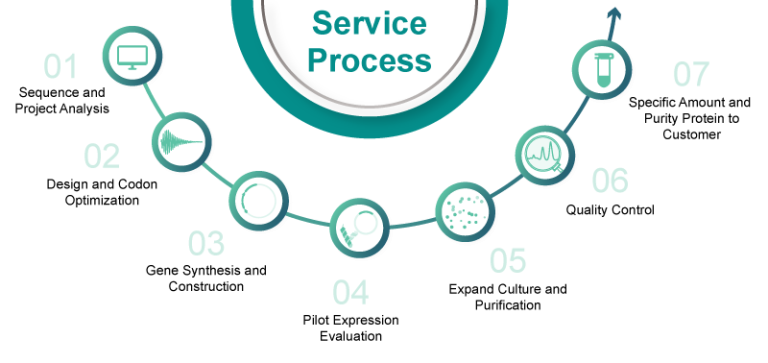
By combining platform-specific expertise with an integrated molecular manufacturing workflow, we help researchers identify suitable expression strategies and streamline the transition from gene design to purified protein delivery.
From gene synthesis to protein expression and purification, Synbio Technologies provides an integrated solution to support your recombinant protein research and development.