DNA Synthesis
 Vector Selection
 Molecular Biology
 Oligo Synthesis
 RNA Synthesis
 Variant Libraries
 Genome KO Library
 Oligo Pools
 Virus Packaging
 Gene Editing
 Protein Expression
 Antibody Services
 Peptide Services
 DNA Data Storage
 Standard Oligo
 Standard Genome KO Libraries
 Standard Genome Editing Plasmid
 ProXpress
 Protein Products

As AI-driven drug discovery advances, the competitive edge is shifting from model performance to integrated Design–Build–Test–Learn (DBTL) capabilities. Ainotype by Synbio Technologies aims to bridge the gap between computational design and experimental validation.
AI Drug Discovery Is Advancing—but a Critical Gap Remains
By 2026, the global clinical pipeline of AI-driven drug candidates had grown from just four programs in 2017 to 179, with nine reaching Phase III clinical trials. Several prominent programs illustrate the field’s growing momentum. Insilico Medicine advanced its TNIK inhibitor from target discovery to a preclinical candidate in just 18 months. Absci has advanced an AI-designed antibody into clinical development, while Generate:Biomedicines continues to advance its long-acting anti-TSLP antibody program.
These milestones suggest that AI-driven drug discovery is beginning to deliver on its promise.
Yet a critical challenge remains. A July 2026 feature inDrug Discovery Newsnoted thatde novo, epitope-guided antibody design is progressing but remains at an early stage. Reported binding success rates are still in the single-digit to low-double-digit percentage range.
The implication is clear: a growing pipeline does not necessarily translate into a high rate of experimental success.
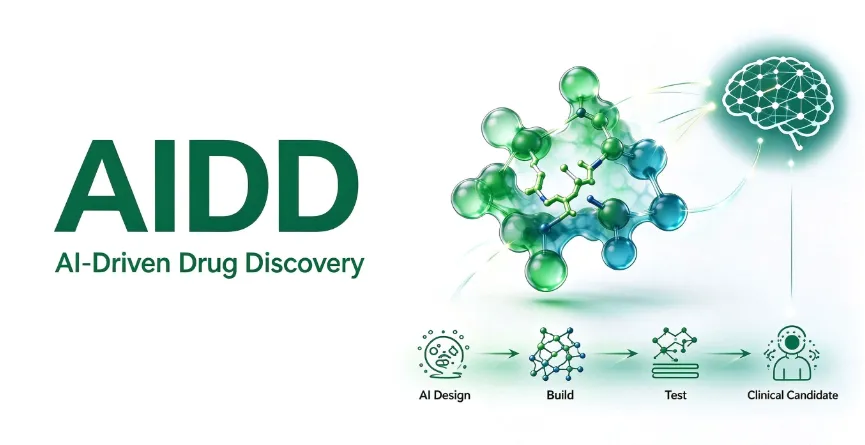
AI can generate molecular structures and predict potential interactions, but a computationally promising design is not automatically a molecule that can be synthesized, expressed, bind its intended target, or demonstrate the properties required for drug development.
The gap between a digital design and a viable biological molecule must be bridged through a complete workflow of synthesis, expression, purification, and experimental validation.
For AI-driven drug discovery (AIDD), the challenge is no longer simply to design a promising molecule. It is to establish a reliable feedback loop connecting computational models with real-world experimental results.
Ainotype: Connecting AI Molecular Design to Experimental Validation
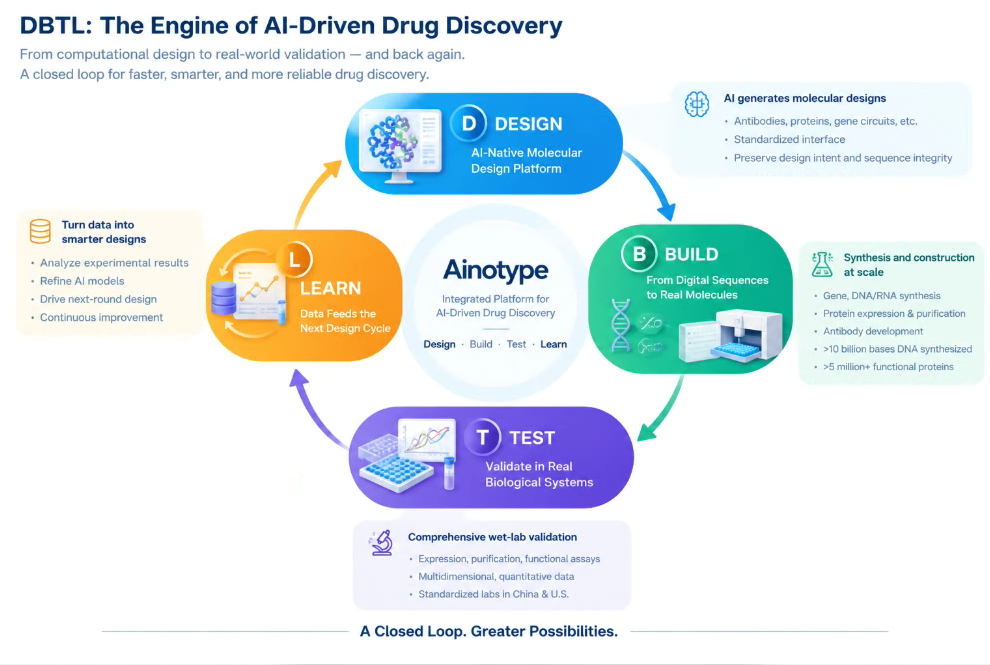
Ainotype is Synbio Technologies’ integrated platform for supporting the experimental execution of AI-driven molecular design.
Built on the Design–Build–Test–Learn (DBTL) framework and backed by 13 years of molecular manufacturing experience, Ainotype brings together capabilities spanning gene synthesis, DNA/RNA synthesis, protein expression and purification, antibody development, and structural analysis.
These capabilities support multiple critical stages of biologics discovery and early-stage validation, helping translate AI-generated designs into physical molecules, measurable experimental results, and ctionable feedback.
DESIGN | Turning AI-Generated Sequences into Buildable Designs
Ainotype is designed to work with AI models developed by external partners through standardized interfaces, enabling computationally generated sequences to enter downstream construction workflows.
The goal is to reduce friction between computational design and experimental execution, allowing AI developers to focus on molecular innovation while connecting their designs to practical laboratory workflows.
BUILD | Converting Digital Sequences into Physical Molecules
Every computationally designed biological molecule must eventually be translated into a physical entity before it can be tested.
When projects involve thousands of candidate sequences, individual synthesis and cloning workflows can significantly increase time, cost, and operational complexity.
Ainotype provides integrated molecular synthesis capabilities to support sequence libraries of varying lengths and complexity. Drawing on Synbio Technologies’track record of more than 10 billion DNA bases synthesized and over five million functional protein constructs, the platform is designed to support the reliable construction of AI-generated molecular designs while maintaining sequence fidelity.
TEST | Validating Designs in Real Biological Systems
Computational predictions must be tested against experimental evidence.
With standardized wet-lab validation capabilities in both China and the United States, Ainotype supports integrated workflows from protein expression and purification to functional assessment.
Well-defined experimental protocols and consistent data quality are essential for generating results that can meaningfully inform subsequent design decisions.
LEARN | Feeding Experimental Data Back into the Next Design Cycle
Experimental validation creates greater value when its results inform the next round of molecular design.
If testing ends with the identification of a few promising candidates, the workflow remains largely linear. A closed-loop approach instead connects AI design, DNA synthesis, protein expression, functional and developability testing, data analysis, and model refinement.
Ainotype aims to support this iterative process by connecting molecular construction and experimental validation with structured data feedback.
Five Factors That Determine the Effectiveness of an AIDD Closed Loop
As AI-generated molecular designs move into experimental validation, platform availability alone is not enough. The real questions concern workflow integration, predefined standards, complex-molecule expertise, cycle time, and data governance.
1. Evaluate the Entire Workflow, Not an Individual Capability
Molecular validation involves more than synthesis or a single functional assay. It may require sequence review, DNA construction, expression troubleshooting, purification, characterization, data interpretation, and redesign.
When these activities are distributed across multiple providers, repeated handoffs can create delays, inconsistent documentation, and information loss.
An integrated workflow can reduce these coordination challenges by connecting the key stages within a more consistent operating framework.
The objective is not simply to consolidate services, but to make the complete design-to-validation process easier to coordinate and evaluate.
2. Define Experimental Standards Before Discussing Price
A meaningful comparison of validation services requires clearly defined deliverables.
Before a project begins, collaborators should align on:
- Scope of testing: Which assays and analytical methods are included?
- Sample requirements: How many candidates and how much material are needed?
- Success criteria: What constitutes a successful result?
- Reproducibility: When are repeat experiments required, and under what conditions?
- Turnaround time: What is the expected timeline for each stage and the complete workflow?
- Failure handling: How will candidates that fail synthesis, expression, or functional testing be addressed?
Without these agreements, an initially attractive price may be offset by additional experiments, unclear responsibilities, and repeated coordination.
Well-defined standards make project expectations more transparent and results easier to interpret.
3. Complex Molecules Reveal the True Depth of Experimental Expertise
AI-generated candidates do not always conform to conventional experimental workflows.
Some designs may present high sequence complexity, low expression yields, poor solubility, aggregation, or other challenges that complicate construction and characterization.
These cases require more than routine execution. They call for coordinated troubleshooting across the DNA-to-protein workflow, informed by experience with complex sequences and challenging molecular constructs.
Drawing on 13 years of molecular manufacturing experience, Synbio Technologies aims to support projects that require this broader combination ofsynthesis,expression, purification, and analytical capabilities.
For AI drug discovery teams, the ability to investigate and resolve experimental bottlenecks is essential to translating computationally promising designs into useful biological evidence.
4. Measure Speed Across the Entire DBTL Cycle
Fast synthesis does not necessarily mean fast discovery. Nor does a rapid assay guarantee an efficient development process.
The overall cycle time also depends on sequence review, construct production, expression optimization, functional testing, data interpretation, and the preparation of the next design iteration.
A more meaningful measure of efficiency is therefore the time required to complete an entire DBTL cycle and generate actionable results for the next round.
By coordinating multiple experimental stages within an integrated workflow, Ainotype aims to help research teams reduce operational friction and accelerate iteration.
5. Establish Data Governance Before Collaboration Begins
Data is a critical asset in AI-driven drug discovery, but its value depends on how it is generated, managed, and protected.
Collaborators should establish clear boundaries around:
- Confidentiality and access to experimental data
- Ownership and permitted use of generated results
- Protection of proprietary sequences and molecular designs
- Whether project data may be used for model training or further optimization
- Responsibilities for data storage, transfer, and retention
These questions should be addressed before experimental work begins, rather than after valuable data and intellectual property have been generated.
Clear data governance helps build trust, protect proprietary research, and establish a sustainable foundation for long-term collaboration.
Building the Infrastructure for the Next Generation of AI Drug Discovery
The evolution of AIDD will depend not only on increasingly capable models, but also on the experimental infrastructure that allows those models to learn from reality.
Ainotype brings together molecular manufacturing, wet-lab validation, and data feedback within a DBTL-oriented framework. Its goal is to help AI drug discovery teams move beyond computational predictions toward experimentally supported molecular development.
Synbio Technologies is launching its AIDD strategic collaboration initiative to support organizations using AI for drug design with integrated wet-lab validation and experimental data feedback solutions.
We also welcome strategic partnerships with AI-driven biological design companies seeking to connect their computational platforms with reliable experimental execution.
AI can propose the next molecule. A well-engineered DBTL loop helps determine whether that molecule works—and what to design next.
To explore strategic collaboration opportunities with Ainotype, connect with the Synbio Technologies team to discuss your molecular design, validation, and data feedback requirements.