
 DNA Synthesis
 Vector Selection
 Molecular Biology
 Oligo Synthesis
 RNA Synthesis
 Variant Libraries
 Genome KO Library
 Oligo Pools
 Virus Packaging
 Gene Editing
 Protein Expression
 Antibody Services
 Peptide Services
 DNA Data Storage
 Standard Oligo
 Standard Genome KO Libraries
 Standard Genome Editing Plasmid
 ProXpress
 Protein Products
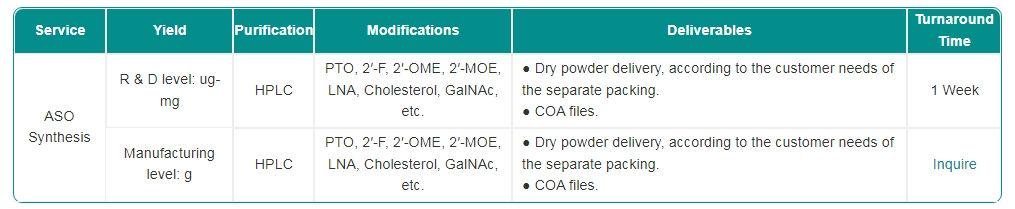
At Synbio Technologies, we focus on providing high-quality ASO Synthesis solutions to researchers and pharmaceutical developers. Understanding the fundamentals of Antisense oligo design is crucial for minimizing off-target effects while achieving precise gene expression inhibition. We have developed a systematic approach that integrates advanced synthesis protocols with comprehensive sequence analysis to ensure the efficiency and specificity of antisense oligonucleotides. Our platform supports projects ranging from early-stage target validation to advanced therapeutic development, allowing users to explore gene modulation with confidence.
Optimizing Sequence Selection for Precision
One of the key strategies we apply in ASO Synthesis involves careful sequence selection. By analyzing target RNA structures and potential off-target regions, our design team can prioritize oligonucleotides with high complementarity and reduced unintended interactions. This Antisense oligo design process includes computational prediction tools that assess hybridization potential and secondary structure accessibility. Through this optimization, we aim to maintain high specificity, which is especially important for projects involving multiple gene targets or complex transcriptomes. Our workflow demonstrates how rational sequence choice directly influences both efficiency and safety in gene expression modulation.
Advanced Chemical Modifications and Delivery Considerations
In addition to sequence design, chemical modifications are essential in ASO Synthesis to improve stability and reduce undesired interactions. We incorporate backbone and sugar modifications that enhance nuclease resistance while maintaining target affinity. Coupled with delivery system considerations, these chemical strategies help minimize off-target binding and increase functional activity in cellular systems. By combining Antisense oligo design with practical synthesis expertise, we provide researchers with reliable tools for preclinical evaluation and translational studies, supporting applications in gene therapy, diagnostics, and RNA-targeted drug discovery.
Ensuring Consistency and Quality Control
Maintaining consistent quality is another core principle in our ASO Synthesis operations. We implement rigorous quality control measures, including analytical verification of oligonucleotide purity and sequence integrity. These checks ensure that researchers receive reproducible materials, reducing experimental variability and enhancing confidence in results. By integrating Antisense oligo design principles with controlled manufacturing processes, we help teams achieve reproducible gene knockdown while avoiding off-target complications. Our platform supports both academic research and industrial applications, highlighting the importance of precise design and synthesis in successful RNA-targeted projects.
Conclusion: Applying ASO Synthesis Principles Effectively
By combining careful sequence selection, chemical modification, and stringent quality control, we at Synbio Technologies demonstrate how ASO Synthesis can minimize off-target effects and improve gene expression inhibition outcomes. Our Antisense oligo design strategies provide practical guidance for researchers working on RNA-targeted therapies and experimental gene modulation. With our platform, teams can confidently pursue gene knockdown projects with optimized specificity, reproducibility, and functional performance, bridging fundamental research and therapeutic innovation.