
 DNA Synthesis
 Vector Selection
 Molecular Biology
 Oligo Synthesis
 RNA Synthesis
 Variant Libraries
 Genome KO Library
 Oligo Pools
 Virus Packaging
 Gene Editing
 Protein Expression
 Antibody Services
 Peptide Services
 DNA Data Storage
 Standard Oligo
 Standard Genome KO Libraries
 Standard Genome Editing Plasmid
 ProXpress
 Protein Products
As part of our ongoing research and development at Synbio Technologies, we continue exploring how ASO Synthesis principles shape the behavior of antisense molecules inside cells. When we evaluate the influence of ASO length and chemical architecture, we focus on how these variables affect both cellular uptake and functional potency. Our work in Antisense oligo analysis helps us understand how sequence length, backbone stability, and chemical modifications interact with intracellular pathways. Through these studies, and through our broader experience in Antisense oligo manufacturing, we aim to offer insights that support safer and more predictable oligonucleotide applications.
How ASO Length Affects Intracellular Movement
ASO length is a foundational factor that influences molecular transport and target binding efficiency. In our ongoing ASO Synthesis programs, we observe that shorter sequences often move more efficiently across cellular membranes due to reduced steric hindrance. At the same time, their hybridization strength must remain adequate to maintain specificity. By examining these relationships through detailed Antisense oligo analysis, we evaluate thermal stability, interaction kinetics, and off-target tendencies associated with different ASO sizes. These findings allow us to adjust sequence design parameters during Antisense oligo manufacturing, creating molecules that achieve balanced transport properties without compromising recognition accuracy.
The Role of Chemical Modifications in Potency
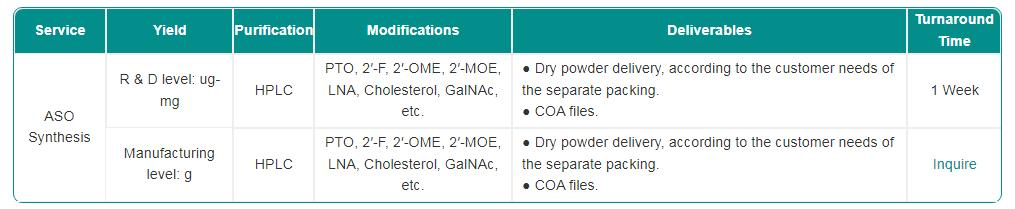
Chemical modifications play a central role in determining ASO potency, especially when interacting with intracellular enzymes and nucleic acid targets. In our ASO Synthesis workflows, we employ chemistries that can support nuclease resistance, facilitate endosomal escape, or enhance hybridization strength. These refinements are analyzed through systematic Antisense oligo analysis, where we assess structural integrity, modification placement, and the resulting functional output. When integrated into our Antisense oligo manufacturing procedures, these chemical strategies help us establish consistent and predictable performance profiles that benefit therapeutic research, genetic studies, and mechanism-focused experiments.
Application Examples and Product Integration
Many modern studies require ASOs that demonstrate predictable behavior across varying cellular environments. Our work with ASO Synthesis and delivery optimization allows us to contribute to these efforts while supporting researchers who need dependable design frameworks. To ensure practical value, we conduct ongoing Antisense oligo analysis to refine molecule length and chemistry for applications such as gene expression modulation or exon targeting. These insights guide improvements in our Antisense oligo manufacturing, aligning them with the needs of research teams seeking stable, customizable ASO products. For users interested in our antisense solutions, we provide a portfolio of options suitable for different study designs, enabling smooth integration into existing workflows.
Conclusion: Connecting Length, Chemistry, and Performance
In conclusion, our work at Synbio Technologies shows that ASO length and chemical structure directly influence cellular uptake, stability, and functional potency. Through careful design rooted in ASO Synthesis, ongoing refinements supported by Antisense oligo analysis, and controlled processes in Antisense oligo manufacturing, we help researchers better understand how these elements shape experimental outcomes. By integrating scientific evaluation with practical product development, we continue supporting ASO applications that require both reliability and flexibility.