
 DNA Synthesis
 Vector Selection
 Molecular Biology
 Oligo Synthesis
 RNA Synthesis
 Variant Libraries
 Genome KO Library
 Oligo Pools
 Virus Packaging
 Gene Editing
 Protein Expression
 Antibody Services
 Peptide Services
 DNA Data Storage
 Standard Oligo
 Standard Genome KO Libraries
 Standard Genome Editing Plasmid
 ProXpress
 Protein Products
In long gene synthesis, sequence length and assembly complexity are closely linked. As the target sequence gets longer, it typically needs to be divided into more fragments, and each additional assembly round introduces another cycle of transformation, screening, and validation.
For a four-fragment construct, a conventional stepwise strategy may require three sequential assembly rounds. Even when every step proceeds smoothly, the timeline can quickly add up. More importantly, every additional round introduces another opportunity for assembly failure, sequence errors, or DNA loss.
In this case study, an 8 kb target gene was divided into four fragments—A, B, C, and D. Using a conventional stepwise strategy, the fragments would be assembled into the final construct over three rounds, with a theoretical minimum timeline of approximately 20 days to obtain the first full-length clone.
Instead, all four correctly synthesized fragments were assembled directly with the linearized vector in a single in vivo recombination step. From receipt of the correct A/B/C/D fragments to recovery of the full-length correct clone, the process was completed in 15 days.
So, what made this one-step assembly possible?
Conventional Assembly: Three Rounds, Three Transformation Cycles
Under a conventional stepwise strategy, the four fragments would typically be assembled as follows:
1. Fragment A → vector
Transformation, screening, and validation.
2. Fragment B → A-containing vector
A second transformation, screening, and validation.
3. Fragments C + D → AB-containing vector
A third transformation, screening, and validation.
Even under ideal conditions, this workflow requires approximately 20 days before the first full-length clone is obtained. This estimate does not include the time required for final sequencing confirmation.
If any intermediate assembly fails because of incorrect joining, sequence errors, or instability, the affected fragment or intermediate construct must be prepared again and the corresponding transformation and screening steps repeated.
The key issue is therefore not simply that each additional assembly round adds time. Each additional round also introduces another opportunity for failure and DNA loss, making the overall workflow increasingly difficult to control.
Why Is One-Step Assembly Challenging?
Assembling four or more DNA fragments simultaneously presents several technical challenges.
1. Lower Assembly Efficiency with More Fragments
As fragment number increases, more homologous junctions must be correctly recognized and assembled simultaneously. With four or more fragments, assembly efficiency can decline, often requiring extensive colony screening.
2. Host Stability with Large Constructs
Large plasmids can place additional replication stress onE. coli and may be more prone to low copy number, rearrangement, or instability. The challenge is to balance high recombination efficiency with plasmid stability.
3. Cumulative Loss from Multiple Assembly Rounds
Each additional assembly cycle adds DNA preparation, transformation, screening, and validation steps, increasing opportunities for DNA loss and failure. For long constructs, fewer assembly cycles can mean a faster and more controlled workflow.
Together, these challenges make direct one-step assembly of multiple fragments difficult under conventional cloning conditions.
Case Study: One-Step Assembly of an 8 kb Gene
To address these challenges, this case employed DH5α-Rec1, a DH5α-derived recombinant strain engineered to maintain enhanced recombination activity while retaining key characteristics required for plasmid propagation.
The strain used in this case has a reported assembly capacity of up to 42 kb and can support assembly of up to 12 fragments under appropriate conditions.
The total recombinant length in this case was approximately 18 kb, including the target sequence and vector. This represents less than half of the reported 42 kb capacity, while the four-fragment assembly was also well below the reported 12-fragment limit.
In other words, the assembly was performed within a defined technical capacity rather than at the edge of the system's reported limits.
How the One-Step Assembly Worked
A critical difference from conventional workflows is that the four DNA fragments were not first assembled into a complete circular plasmid in vitro.
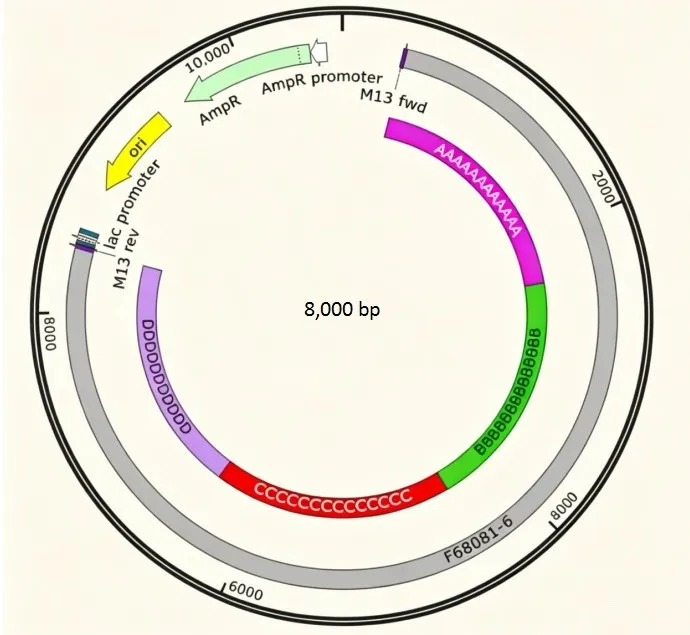
Instead, the four correctly synthesized fragments—A, B, C, and D—were combined with the linearized vector at an appropriate ratio and introduced directly into DH5α-Rec1 competent cells.
Following transformation by heat shock or electroporation, the homologous regions at the ends of the DNA fragments were recognized by the recombination machinery maintained by the host cells. The fragments and vector were then assembled inside the cells, generating the complete circular plasmid.
In this workflow, the competent cells serve two functions:
✔ The site of recombination, where the DNA fragments are assembled into the final construct.
✔ The host for propagation, allowing the correctly assembled plasmid to be recovered and expanded.
This distinction is important. The four fragments do not need to be fully joined into a circular plasmid before transformation. Instead, the cellular recombination system performs the assembly after the DNA enters the host.
15 Days from Correct Fragments to Full-Length Clone
Using this one-step strategy, the workflow was completed in 15 days from receipt of the correct A/B/C/D fragments to recovery of the full-length correct clone.
The practical advantage is not simply fewer days on the calendar. Fewer assembly cycles mean fewer transformation, screening, and recovery steps—and fewer opportunities for intermediate failure.
Addressing Challenging Sequence Features
The target sequence in this case presented additional design considerations. Overall, the sequence was GC-poor and contained small hairpin structures.
Low-GC regions can provide weaker hybridization or annealing interactions, potentially affecting the efficiency of homologous recombination. Meanwhile, local secondary structures such as hairpins can interfere with DNA accessibility and fragment pairing.
The enhanced recombination activity of DH5α-Rec1 helped compensate for the reduced pairing strength associated with the low-GC sequence.
More importantly, the one-step strategy reduced the number of times these sequence features could interfere with the assembly process. Instead of exposing the sequence to potential assembly-related challenges across three separate rounds, the complete fragment set was brought together in a single recombination event.
Synbio Technologies' Long Gene Synthesis Workflow
For long gene synthesis, the major bottleneck is not always fragment synthesis itself. In many cases, the assembly strategy determines how efficiently those fragments can become a verified full-length construct.
Based on experience with multi-fragment in vivo recombination, Synbio Technologies applies a strategy that evaluates whether long constructs can be assembled directly rather than automatically defaulting to sequential assembly.
✔ One-Step Assembly Strategy
For long genes divided into three or four fragments, the feasibility of single-step recombination can be evaluated during project design to reduce unnecessary intermediate assembly cycles.
✔ In Vivo Recombination
Correct DNA fragments and the linearized vector can be introduced into an appropriate recombination-competent host, allowing multi-fragment assembly to occur directly inside the cell.
✔ Compatibility with Challenging Sequences
Sequence characteristics such as low GC content, hairpin structures, and local secondary structures can be considered during fragment design. Homology-arm design and assembly conditions can then be adapted to the sequence context.
✔ Controlled Timeline and Full-Length Validation
By reducing the number of sequential assembly steps, the workflow can shorten the path from synthesized fragments to a full-length clone while maintaining downstream clone screening and sequence verification.
Longer sequences do not necessarily have to mean longer assembly workflows. The key is choosing an assembly strategy that matches the sequence, construct size, and technical requirements of the project.