
 DNA Synthesis
 Vector Selection
 Molecular Biology
 Oligo Synthesis
 RNA Synthesis
 Variant Libraries
 Genome KO Library
 Oligo Pools
 Virus Packaging
 Gene Editing
 Protein Expression
 Antibody Services
 Peptide Services
 DNA Data Storage
 Standard Oligo
 Standard Genome KO Libraries
 Standard Genome Editing Plasmid
 ProXpress
 Protein Products
From Natural Genetic Coding to AI-Driven Biological Intelligence
The evolution of biological coding can be viewed as three successive eras, each defined by its underlying design paradigm, technological capabilities, and primary creator. Every stage has expanded the boundaries established by the one before it.
Era 1: Genotype -Nature's Original Code
Synthetic biology traces its origins to the decoding of the genetic blueprint. In 1953, Watson and Crick unveiled the double-helix structure of DNA[1], revealing how biological information is stored. Over the following decades, biology was largely devoted to reading nature's code—from genome sequencing to gene function analysis—as scientists sought to understand the products of billions of years of evolution.
A major turning point came in 2000, when researchers engineered the first genetic toggle switch[2] and repressilator[3] in E. coli, marking the beginning of modern synthetic biology. During this era, biological design remained fundamentally dependent on naturally evolved genomes. Even with transformative technologies such as CRISPR-Cas9, scientists were primarily editing existing genetic information rather than creating entirely new biological systems.
Era 2: Synotype — The Age of Human-Designed Biology
The concept of Synotype extends beyond genotype and phenotype to describe genes, genomes, and biological pathways intentionally designed and synthesized by humans.
This era began with a milestone in 2010, when Craig Venter's team created the first synthetic cell containing a chemically synthesized genome[4]. Subsequent achievements—including the first synthetic eukaryotic chromosome[5] and the Sc2.0 synthetic yeast genome project—demonstrated that biology could be engineered rather than merely modified.
During this period, gene synthesis, genome editing, and DNA sequencing advanced together, enabling DNA to be treated as programmable code and cells as engineering platforms.
However, human creativity remains constrained by biology's enormous sequence space. A typical protein consisting of hundreds of amino acids has more possible sequence combinations than there are atoms in the observable universe. Human intuition can explore only a tiny fraction of these possibilities.
Era 3: Ainotype — AI-Native Biological Design
We are now entering the era of Ainotype—a new generation of DNA, RNA, XNA, and protein sequences created directly by artificial intelligence.
Unlike molecules produced through natural evolution or traditional human design, Ainotype molecules are digitally native biological entities generated by AI models and optimized for biological function.
Since 2022, generative AI has rapidly transformed molecular engineering. AI is no longer limited to analyzing biology—it is beginning to create entirely new functional biomolecules.
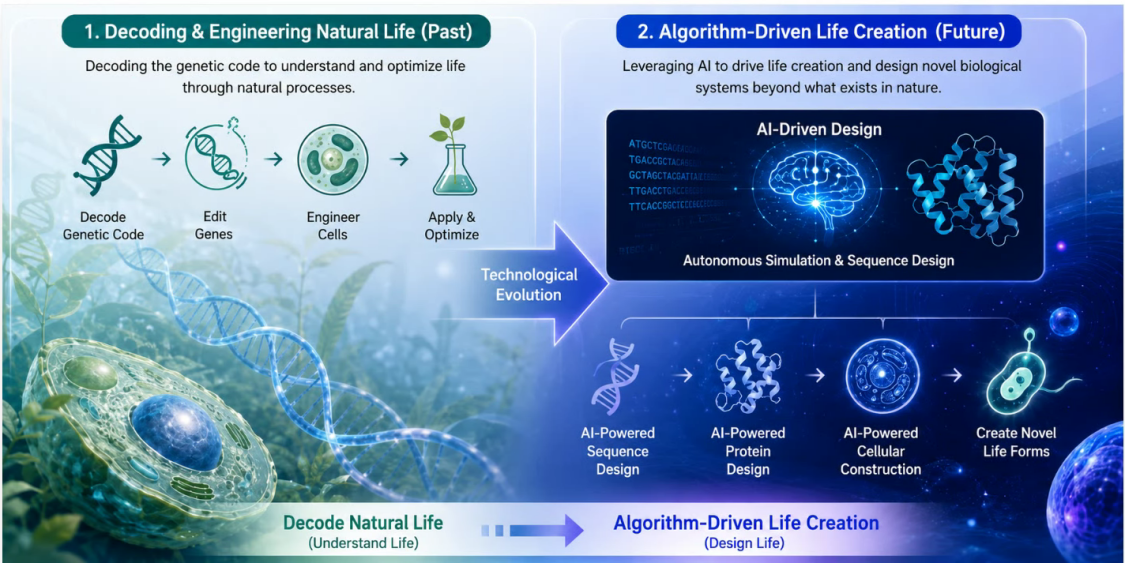
Recent breakthroughs clearly demonstrate this shift:
-
David Baker's team[6] used RFdiffusion2 to design antibodies with near-atomic structural accuracy.
-
The MMDesign platform[7] achieved high-success de novo nanobody design with only dozens of experimental candidates per target.
-
The Germinal framework generated epitope-specific antibodies with minimal experimental screening[8].
-
The world's first AI-designed CAR-T therapy has entered clinical development[9].
Together, these advances signal that AI-native biomolecules are rapidly transitioning from computational predictions to real-world therapeutics.
The Remaining Challenge: Bridging AI and Biology
Despite remarkable progress in AI-driven molecular design, a critical gap remains between digital predictions and biological reality.
Most AI models are trained primarily on public datasets with limited experimental feedback. As a result, they cannot reliably predict real-world characteristics such as protein expression, stability, immunogenicity, manufacturability, or in vivo performance.
Wet-lab validation is also expensive, time-consuming, and often produces only binary outcomes instead of rich quantitative measurements such as binding affinity, expression level, thermal stability, cellular activity, or structural information.
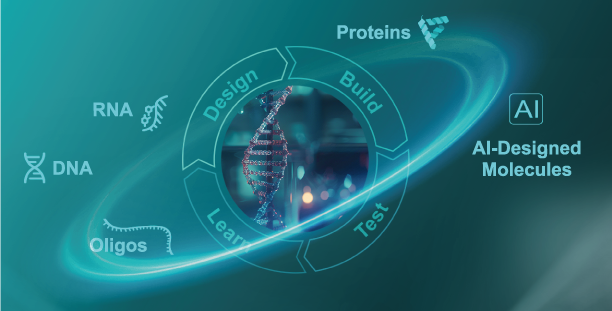
Meanwhile, AI developers and experimental laboratories frequently operate with incompatible data standards, preventing valuable experimental results from being efficiently incorporated into model training. Without a closed Design-Build-Test-Learn (DBTL) cycle, AI cannot continuously improve through real biological feedback.
Ainotype Platform: An AI-to-Lab Validation Engine
In 2025, Synbio Technologies introduced the Ainotype Platform, an AI-to-API validation engine designed to bridge computational molecular design with experimental biology.
Built on the DBTL framework and backed by over 13 years of molecular manufacturing experience—including billions of synthesized DNA bases and more than five million functional protein constructs—the platform enables a seamless workflow from AI-generated sequences to validated biological products.
-
Design
An open interface accepts AI-generated molecular designs, including antibodies, synthetic genes, engineered proteins, and genetic circuits, while preserving every design detail throughout downstream workflows.
-
Build
High-throughput molecular manufacturing capabilities include gene synthesis, vector construction, stable cell line development, antibody library generation, CRISPR genome engineering, and additional synthetic biology services.
-
Test
Standardized wet-lab validation is performed across Synbio Technologies' laboratories in the United States and China, covering expression, purification, functional screening, and structural characterization.
-
Learn
Instead of returning simple pass/fail results, the platform delivers standardized, multidimensional experimental datasets—including affinity, expression, stability, activity, and structural measurements—that can be directly integrated into AI model retraining.
Every validation cycle generates high-quality biological data that continuously improves AI model performance, creating a true closed-loop DBTL system.
Accelerating AI-Native Drug Discovery
The Ainotype Platform delivers several strategic advantages:
* Improves wet-lab success rates for AI-designed molecules.
* Reduces the timeline from AI design to experimental validation from years to weeks or months.
* Significantly lowers the cost of early-stage biologics discovery.
* Continuously generates high-quality experimental datasets that enable AI models to evolve through real biological feedback.
A New Era of AI-Native Biology
AI-generated biomolecules are no longer theoretical concepts—they are becoming a new class of biological innovation.
As artificial intelligence, laboratory automation, and synthetic biology continue to converge, biological discovery is evolving toward a future in which molecules are designed by AI, validated through high-throughput experimentation, and continuously optimized through data-driven learning.
The Ainotype Platform is designed to power this transformation, enabling a faster, smarter, and more scalable future for AI-driven biologics discovery and molecular engineering.
Reference
[1]. WATSON JD, CRICK FH. Molecular structure of nucleic acids; a structure for deoxyribose nucleic acid. Nature. 1953 Apr 25;171(4356):737-8.
[2]. Gardner T S, Cantor C R, Collins J J. Construction of a genetic toggle switch in Escherichia coli[J]. Nature, 2000, 403(6767):339-342.
[3]. Elowitz M B, Leibler S. A synthetic oscillatory network of transcriptional regulators[J]. Nature, 2000, 403(6767):335-338.
[4]. Gibson D G, Glass J I, Lartigue C, et al. Creation of a Bacterial Cell Controlled by a Chemically Synthesized Genome[J]. Science, 2010, 329(5987):52-56.
[5]. Annaluru N, Muller H, Mitchell L A, et al. Total Synthesis of a Functional Designer Eukaryotic Chromosome[J]. Science, 2014, 344(6179):55-58.
[6]. Liu C, Wu K, Baker D, et al. Diffusing protein binders to intrinsically disordered proteins. Nature. 2025 Aug;644(8077):809-817.
[7]. The MoleculeMind Team. (2026, June 3). Practical De Novo Nanobody Discovery with Tens of Experimental Candidates. Zenodo.
[8]. Mille-Fragoso L S, et al. Efficient generation of epitope-targeted antibodies with Germinal [J]. Nature Biotechnology, 2026.
[9]. Callaway E. What will be the first AI-designed drug? These disease-fighting antibodies are top contenders[J]. Nature News, 09 December 2025.