
 DNA Synthesis
 Vector Selection
 Molecular Biology
 Oligo Synthesis
 RNA Synthesis
 Variant Libraries
 Genome KO Library
 Oligo Pools
 Virus Packaging
 Gene Editing
 Protein Expression
 Antibody Services
 Peptide Services
 DNA Data Storage
 Standard Oligo
 Standard Genome KO Libraries
 Standard Genome Editing Plasmid
 ProXpress
 Protein Products
Are you still navigating a lengthy and uncertain workflow from gene synthesis to cloning to expression validation?
Do you find yourself waiting on sequencing results, induction steps, and gel analysis, only to see your project timeline extend into weeks or longer?
If you are looking for a faster way to confirm whether your gene construct truly works, the rapid gene synthesis and expression validation workflow introduced here may be exactly what you need.
Traditional Workflow: Reliable but Time Intensive
Conventional gene synthesis and expression validation workflows are well established, but they come with several clear limitations:
-
Sequential dependency
Each step depends entirely on completion of the previous one, which slows overall progress.
-
Delayed expression validation
Expression testing typically begins only after sequence verification, followed by transformation into expression strains such as BL21(DE3), induction, and SDS PAGE analysis.
-
Labor and time intensive processes
IPTG induction requires manual monitoring of optical density, which makes high throughput parallel experiments difficult to manage.
Optimized Workflow: Integrated, Parallel, and Faster
To address these challenges, the workflow has been redesigned around a three in one integration strategy:
-
Direct cloning in JM109(DE3)
-
Auto induction media
-
Protein detection strip
These elements create a rapid and reliable expression validation platform.
This workflow is especially well suited for synthetic biology, antibody engineering, and enzyme engineering applications, where large numbers of constructs require fast functional screening. It reduces the early stage build to test cycle from weeks to just days.
Protein Detection Strip: Results in 2 Minutes
Expression validation no longer needs to rely on next day gel analysis.
Using the proXpress protein detection strip, qualitative detection of common tags such as His tag or GST tag can be completed in approximately two minutes.
√ Positive result with visible band
Confirms correct gene sequence, a functional expression system, and successful tag expression.
√ PNegative result with no band
Identifies issues early and prevents unnecessary downstream effort.
This is more than a simple assay. It provides early confidence that your construct is expressible before moving into purification and functional studies.
Case Study: Speed and Reliability in Practice
In real project applications:
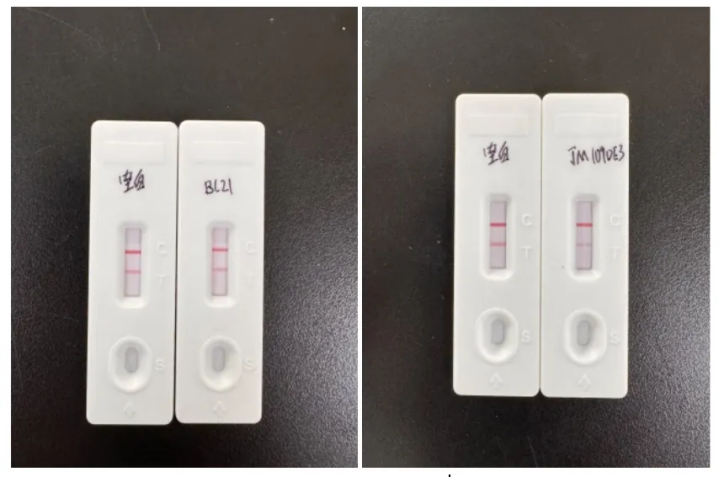
Protein detection strip results showed successful expression in both JM109(DE3) and BL21(DE3), confirming plasmid integrity and functionality.
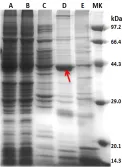
Traditional SDS PAGE analysis further validated expression after scale up in BL21(DE3).
To date, more than 200 gene synthesis projects have been validated using the gene synthesis plus proXpress detection workflow, reducing average turnaround time by over 50 percent.
Synbio Technologies: Gene Synthesis-V
At Synbio Technologies, time is treated as a critical factor in workflow optimization. By integrating advanced gene synthesis with rapid protein expression validation, we provide a direct and efficient path to expression results:
√ PDirect cloning in JM109(DE3)
Eliminates subcloning steps and enables immediate entry into an expression ready system
√ PAutomated cultivation with auto induction
Supports stable, uniform, and high throughput protein expression without manual handling
√ PRapid validation with proXpress detection strip
Delivers immediate expression confirmation, supported by enhanced COA reports
What You Gain
Faster results
Compress the timeline from synthesis to expression validation and accelerate project initiation.
More accurate clone selection
Identify high expression clones early and reduce resource intensive trial and error.
Accelerated downstream workflows
Enable faster progression into protein purification, functional characterization, and structural studies.