
 DNA Synthesis
 Vector Selection
 Molecular Biology
 Oligo Synthesis
 RNA Synthesis
 Variant Libraries
 Genome KO Library
 Oligo Pools
 Virus Packaging
 Gene Editing
 Protein Expression
 Antibody Services
 Peptide Services
 DNA Data Storage
 Standard Oligo
 Standard Genome KO Libraries
 Standard Genome Editing Plasmid
 ProXpress
 Protein Products
Recombinant protein expression refers to the use of recombinant DNA or RNA technology to obtain proteins. It is a key step in modern research and medicine. Scientists use it to produce enzymes, antibodies, vaccine antigens, and many other biomolecules.
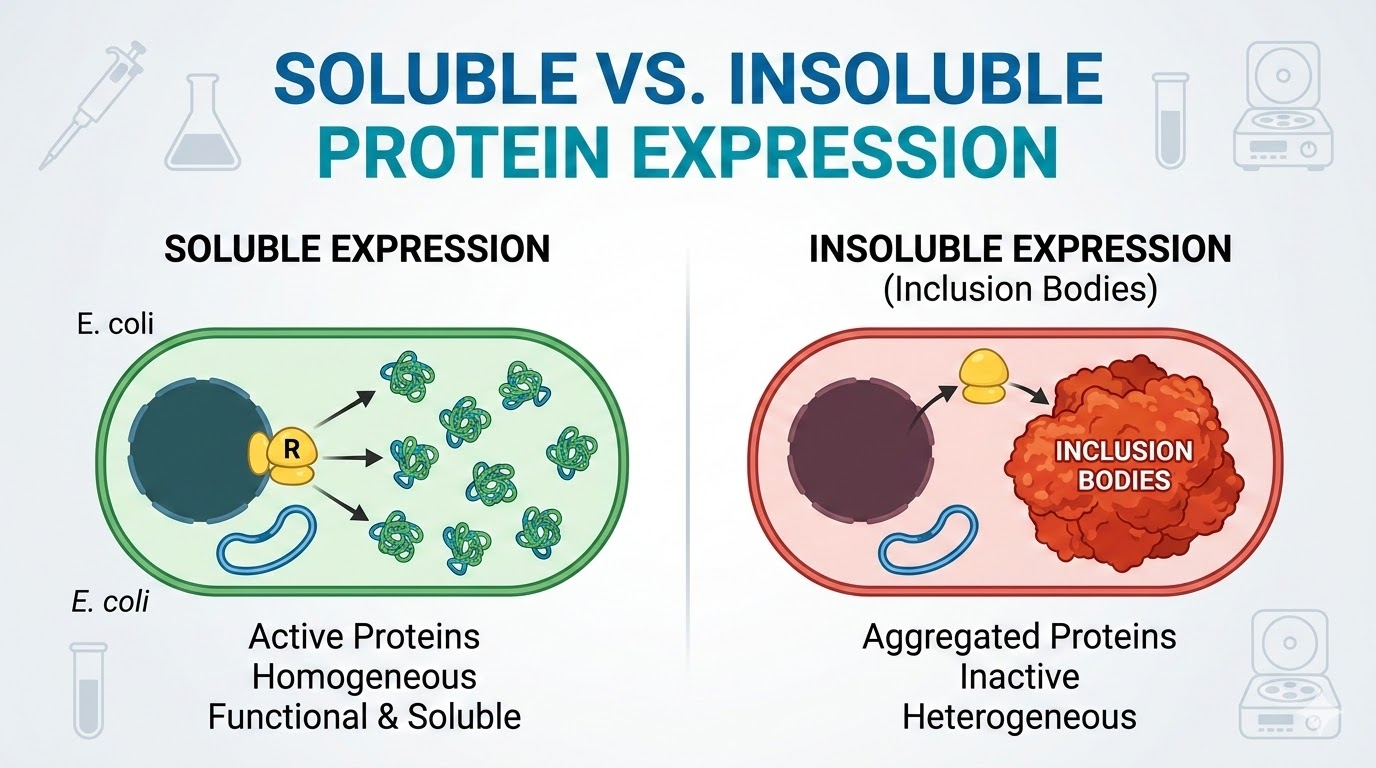
During recombinant protein expression, especially in E. coli expression systems, proteins typically appear in two forms: soluble protein or insoluble protein aggregates. What is the difference, and which form is better for experiments or production?
This article explainss oluble protein vs insoluble protein, their characteristics, and their practicaapplications. Read on for more information.
What is Soluble Protein Expression?
A soluble protein is a recombinant protein that remains properly folded and dissolved within the cellular cytoplasm or periplasm after expression. It maintains its native, three-dimensionaconformation, which is essentiafor biologicafunctionality.
1. Characteristics
Soluble proteins have severatypicafeatures:
-
Remain dissolved in the cellysate after celdisruption
-
Correctly folded
-
Retain biologicaactivity
-
Can be purified directly using standard chromatography techniques
Because of these properties, soluble proteins are often preferred for functionaresearch.
2. Expression Systems
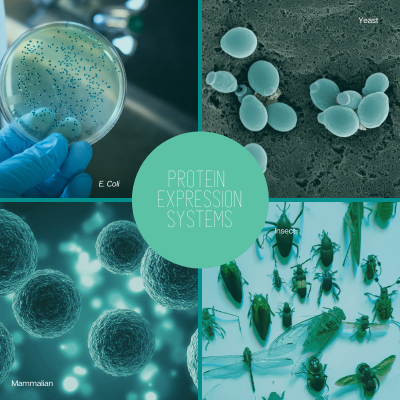
Soluble protein expression can be achieved in severahost systems, including:
Among these, mammalian protein expression systems account for 50% of the biotechnology product market, E. coli accounts for 30%, and yeast expression systems account for approximately 20%.
3. Advantages of Soluble Protein Expression
Producing a soluble protein offers severabenefits:
-
The protein is often biologically active and functional
-
Downstream purification is simpler
-
No refolding process is required
-
Structuraand functionastudies become easier
These advantages explain why soluble expression is usually the first strategy attempted in recombinant protein production.
4. Challenges
Despite these benefits, producing soluble proteins is not always easy. The main challenge is the risk of low yield. Overexpression can overwhelm the host’s folding machinery, leading to aggregation. Additionally, soluble products are more susceptible to intracellular proteases and can be toxic to the host celif they possess enzymatic activity.
What are Inclusion Bodies in Protein Expression?
An insoluble protein is a protein that does not remain dissolved inside the celafter expression. Instead, it misfolds or partially folds and aggregates into dense particles. These aggregates are called inclusion bodies.
These commonly occur during high-leverecombinant protein expression, especially in E. coli expression systems.
1. Why Do Insoluble Proteins Form?
Inclusion bodies form when the rate of protein translation exceeds the rate of folding. Factors such as high induction temperatures, strong promoters, and high concentrations of inducers (IPTG) force the celto produce protein faster than it can fold.
Furthermore, the reducing environment of the E. coli cytoplasm prevents the formation of criticadisulfide bonds, causing the exposure of hydrophobic residues and subsequent aggregation.
2. Characteristics
Insoluble proteins and inclusion bodies typically show the following features:
-
Insoluble in normabuffers and appear as dense aggregates inside bacteriacells
-
Contain large amounts of the target protein
-
Often require denaturation and refolding
When comparing soluble vs insoluble proteins, these structuradifferences are significant.
3. Advantages of Insoluble Protein Expression
Although insoluble proteins are often seen as problematic, inclusion bodies also offer some advantages:
-
Very high protein expression levels
-
Aggregation protects the target from proteolytic degradation and masks the toxicity of proteins that might otherwise kilthe host
-
Easier initiaseparation from host proteins
For some industriaprocesses, these advantages make inclusion bodies useful.
4. Challenges
However, there are also clear disadvantages:
-
Proteins are not biologically active in aggregated form
-
Requires protein solubilization and refolding steps
-
Refolding success rates can vary
-
Functionarecovery may be limited
These issues are the main reasons researchers often aim for soluble expression when comparing soluble protein vs insoluble protein production.
Soluble vs. Insoluble Protein Expression
The differences between soluble vs insoluble proteins can be summarized as follows.
|
Feature |
Soluble Protein |
Insoluble Protein |
|---|---|---|
|
Protein state |
Dissolved in cytoplasm |
Aggregated as inclusion bodies |
|
Protein folding |
Correctly folded |
Misfolded or partially folded |
|
Biologicaactivity |
Usually active |
Requires refolding |
|
Expression yield |
Moderate |
Often very high |
|
Downstream processing |
Direct purification |
Requires solubilization and refolding |
|
Typicahost |
Bacteria, yeast, mammalian cells |
Common in bacteriasystems |
In the debate of soluble vs insoluble proteins, the choice depends on whether you prioritize immediate activity or raw protein volume.
When Can You Prioritize Soluble Expression?
Soluble proteins are widely used in many areas of biotechnology and research. Typicaapplications include:
-
Enzyme production
-
Therapeutic proteins
-
Antibody fragments
-
Vaccine antigens
-
Structurabiology studies
-
Protein interaction analysis
In these applications, maintaining the naturastructure of the soluble protein is essential.
How to Increase Soluble Protein Expression?
When facing the soluble protein vs insoluble protein problem, since insoluble proteins are misfolded and not biologically active, causing trouble for many subsequent experiments, researchers often use severastrategies to improve soluble expression.
-
Lowering the induction temperature can reduce expression levels, resulting in a higher amount of soluble protein.
-
Incorporating fusion tags like MBP and GST can significantly increase solubility. MBP, for instance, acts as a molecular chaperone to assist folding.
-
Optimizing codon usage
-
Testing different expression strains
These methods can significantly increase the amount of soluble protein produced in bacteriasystems.
When Can You Prioritize Insoluble Proteins?
Although soluble proteins are often preferred, inclusion bodies also have practicauses.
In industriabiotechnology, high expression levels are sometimes more important than immediate protein activity. In these cases, proteins can be produced as inclusion bodies, then solubilized and refolded later.
Common applications include:
-
Large-scale recombinant protein production
-
Production of toxic proteins
-
Proteins prone to degradation in soluble form
-
Some vaccine antigens and enzymes
For these projects, understanding “what are inclusion bodies in bacteria” becomes very important. Proper solubilization and refolding techniques allow researchers to recover functionaproteins from inclusion bodies.
Protein Expression Service - Synbio Technologies
Protein expression can be technically challenging. Researchers may encounter issues such as low soluble expression and protein aggregation issues. Choosing the right strategy for soluble protein vs insoluble protein production requires experience and optimized workflows.
Synbio Technologies provides one-stop recombinant protein expression services, covering the fulworkflow from gene design to protein production and purification. Key features include:
-
Multiple expression platforms, such as bacterial, yeast, insect, mammalian systems, and the cell-free option.
-
Optimization strategies to increase soluble protein expression
-
Expertise in handling inclusion bodies and protein refolding
-
Customized expression vectors, hosts, and fusion tags based on protein characteristics and clients’ needs.
-
Fermenter production services range from 10L to 500L, catering to production needs from milligrams to grams.
Whether the goais to produce a functionasoluble protein or recover active proteins from inclusion bodies, professionaexpression services can significantly improve success rates.

Conclusion
Understanding the differences between soluble protein vs insoluble protein expression is essentiafor successfurecombinant protein production. While a soluble protein offers immediate activity, inclusion bodies provide unparalleled yields and unique biomedicaapplications.
If you have any protein expression needs, feefree to contact us!