
 DNA Synthesis
 Vector Selection
 Molecular Biology
 Oligo Synthesis
 RNA Synthesis
 Variant Libraries
 Genome KO Library
 Oligo Pools
 Virus Packaging
 Gene Editing
 Protein Expression
 Antibody Services
 Peptide Services
 DNA Data Storage
 Standard Oligo
 Standard Genome KO Libraries
 Standard Genome Editing Plasmid
 ProXpress
 Protein Products
A recent outbreak of Nipah virus (NiV) in West Bengal, eastern India, has once again raised alarms over global public health security. According to reports on January 26, five confirmed cases have been identified, with nearly 100 individuals placed under quarantine. Neighboring countries, including Thailand and Nepal, have tightened border health screening. The concern surrounding this outbreak stems from the virus’s exceptionally high fatality rate and epidemic potential.
A High-Fatality Threat: Clinical Features and Challenges
The World Health Organization (WHO) has classified Nipah virus as a priority pathogen due to its alarming mortality rate, which historically ranges from 40% to 75%. The incubation period typically spans 4–14 days, but may extend up to 45 days, complicating containment efforts.
Clinical manifestations vary widely—from asymptomatic infection to acute respiratory illness and fatal encephalitis. Early symptoms such as fever, headache, myalgia, vomiting, and sore throat are often indistinguishable from influenza, delaying diagnosis. Disease progression can be rapid, leading to dizziness, drowsiness, confusion, coma, or severe pneumonia. Encephalitis may result in permanent neurological damage, with approximately 20% of survivors experiencing long-term sequelae.
To date,no approved antiviral drugs or vaccines are available, making each outbreak a critical challenge for global health systems.
Understanding the Virus: Structure and Pathogenesis
Viral Structure
Nipah virus is a highly lethal zoonotic pathogen belonging to the Paramyxoviridae family and contains a single-stranded RNA genome. Its lipid envelope is embedded with key G (attachment) and F (fusion) glycoproteins, while the matrix (M) protein forms the viral scaffold. The genome is encapsidated by N, P, and L proteins.
Notably, the virus produces immune-evasion proteins such as V and W through P-gene editing, enabling suppression of host interferon responses and facilitating early immune escape. These molecular features form the foundation for diagnostic and therapeutic development[1] .
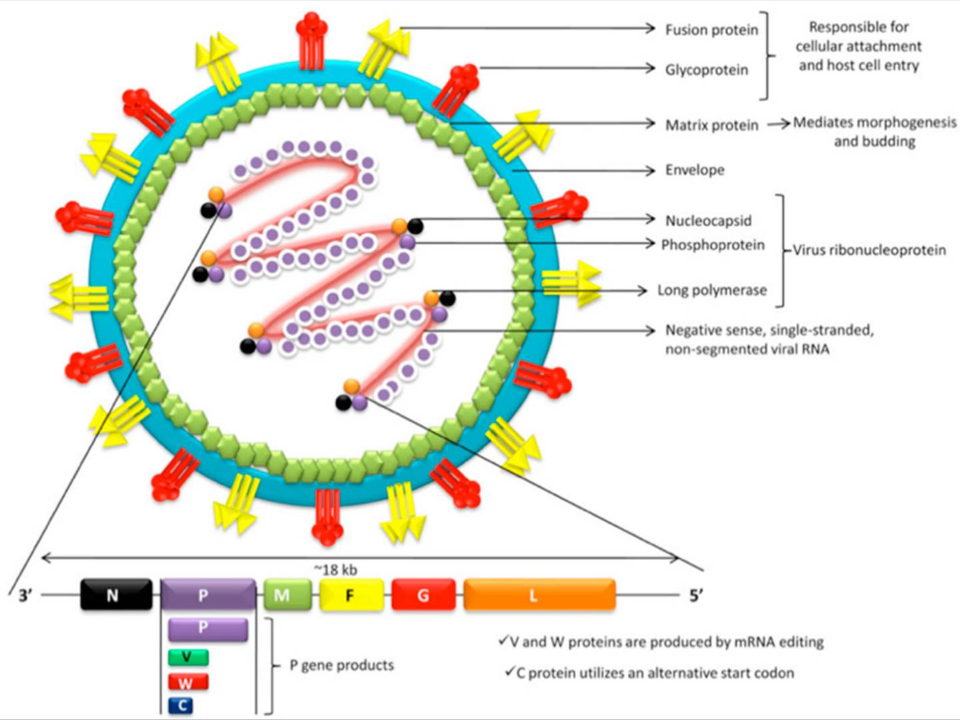
Nipah virus structure[1]
Pathogenic Mechanism
NiV typically enters the host through the oral or nasal mucosa, followed by systemic dissemination via the bloodstream. The virus can invade the central nervous system either by crossing the blood–brain barrier or through olfactory nerve pathways. Its strong tropism for tissues expressing Ephrin-B2/B3 receptors leads to secondary infection of the brain, blood vessels, and smooth muscle.
This process triggers robust inflammatory responses, with elevated cytokines such as IL-6, IL-8, TNF-α, and G-CSF, contributing to tissue damage and clinical pathology[2] .
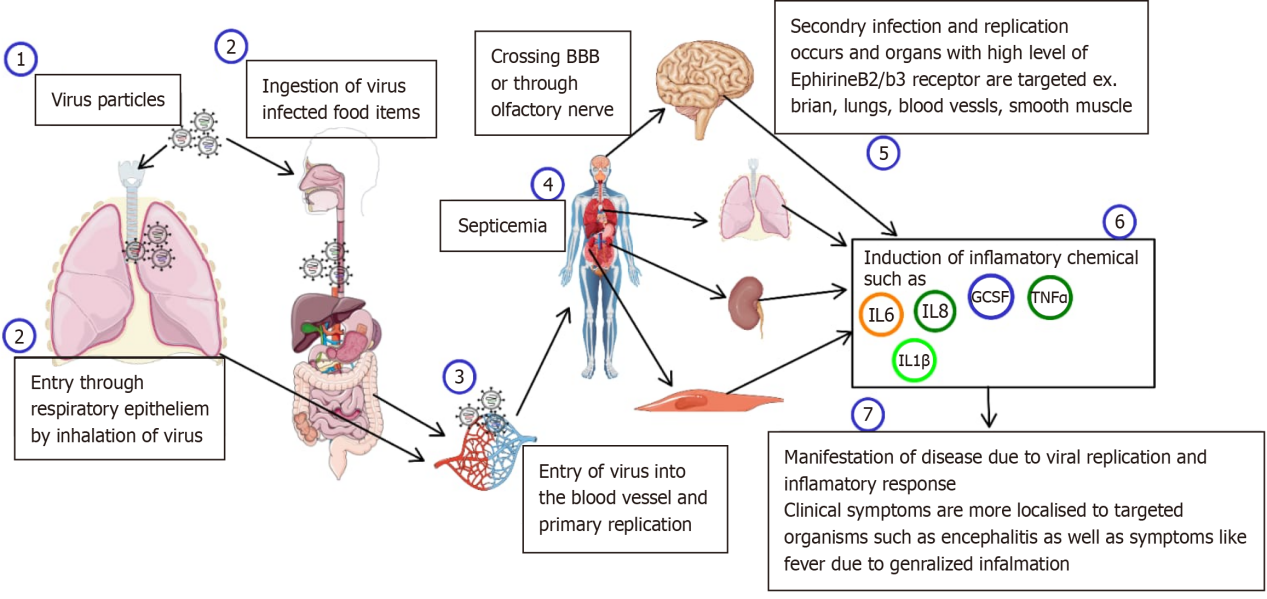
Research Frontiers: Key Areas of Focus
With no specific treatments available, current clinical management relies on patient isolation and supportive care, including respiratory support and control of cerebral edema.
Scientific research is advancing along three primary directions:
-
Antiviral drug development targeting key viral components such as the L–P polymerase complex
-
Vaccine development, with multiple candidates in preclinical or early clinical stages
-
Mechanistic studies exploring how viral proteins (e.g., V and W) modulate host cellular responses and drive pathology
In this context, advanced biotechnology platforms are playing an increasingly critical role in accelerating research.
Empowering Research: Synbio Technologies’ Integrated Solutions
As an AI-enabled synthetic biology innovator, Synbio Technologies addresses the urgent needs of Nipah virus research by integrating cutting-edge platforms to support the full research pipeline—from basic science to applied development.
Key Solutions Include:
NiV Gene Synthesis & Plasmid Construction
Rapid, high-precision gene synthesis and plasmid DNA preparation tailored for virology research and diagnostic reagent development.
Primer & Probe Design and Synthesis
Highly specific RT-PCR and qPCR primers/probes designed to avoid cross-reactivity with related viruses (e.g., dengue), ensuring diagnostic accuracy.
Targeted siRNA Design and Synthesis
Efficient siRNA platforms targeting key NiV structural proteins to facilitate functional studies and antiviral target discovery at the cellular level.
Recombinant NiV Protein & Antibody Expression
Cost-effective, scalable production of high-quality viral recombinant proteins using optimized E. coli expression systems for immunological studies and diagnostic development.
End-to-end antibody customization—from antigen design to antibody generation—supporting therapeutic antibody research and assay development.
Conclusion
Each emergence of Nipah virus is a stress test for global public health defenses. In an interconnected world, scientific innovation, sustained research, and international collaboration remain the most effective tools against emerging lethal pathogens. From genetic decoding to technology empowerment, Synbio Technologies stands alongside the global scientific community to accelerate understanding and countermeasures against Nipah virus—advancing science in defense of human health.
Reference
[1] Faus-Cotino J, Reina G, Pueyo J. Nipah Virus: A Multidimensional Update. Viruses. 2024 Jan 25;16(2):179. doi: 10.3390/v16020179. PMID: 38399954; PMCID: PMC10891541.
[2] Tyagi S, Upadhyay S, Bharara T, Sahai S. Nipah virus: Preventing the next outbreak. World J Clin Cases 2025; 13(11): 99748 [PMID: 40242230 DOI: 10.12998/wjcc.v13.i11.99748]