
 DNA Synthesis
 Vector Selection
 Molecular Biology
 Oligo Synthesis
 RNA Synthesis
 Variant Libraries
 Genome KO Library
 Oligo Pools
 Virus Packaging
 Gene Editing
 Protein Expression
 Antibody Services
 Peptide Services
 DNA Data Storage
 Standard Oligo
 Standard Genome KO Libraries
 Standard Genome Editing Plasmid
 ProXpress
 Protein Products
With the continuous advancement of precision molecular diagnostics the performance of fluorescent probes has become one of the key factors determining the accuracy of qPCR experiments. Especially in challenging applications such as SNP genotyping low copy detection pathogen typing and mutation screening traditional TaqMan probes often struggle to balance sensitivity and specificity.
Minor Groove Binder MGB probe technology has emerged as an important solution for highly specific qPCR detection due to its short sequence high stability and strong discrimination capability.
This article provides a systematic overview of MGB probe technology including its technical principles performance advantages and major applications along with a comparison with other modified probe technologies.
qPCR Detection Method
The TaqMan probe is one of the most widely used fluorescent hydrolysis probes. Its basic structure includes
5 prime fluorescent reporter dye
3 prime quencher
When the probe is intact fluorescence is quenched. During PCR amplification DNA polymerase hydrolyzes the probe which releases the fluorescent signal and enables real time detection.
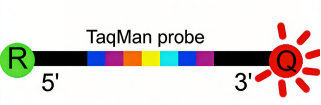
This technology offers good stability and broad applicability but it also shows limitations in high precision detection including:
 Probe length constraints
Limited ability to distinguish single nucleotide mutations
Background fluorescence affecting signal to noise ratio
Difficult probe design in high GC regions
To address these limitations MGB modified probes were developed.
Principle of MGB Probe Technology
Minor Groove Binder MGB is a class of molecules that selectively bind to the minor groove of double stranded DNA. A common structure is a dihydrocyclopyrrolo tripeptide derivative. When MGB is attached to the 3 prime end of a probe it significantly enhances the binding stability between the probe and the target sequence.
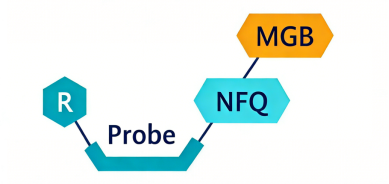
A typical MGB probe consists of three main components
5 prime fluorescent reporter dye
3 prime non fluorescent quencher NFQ
3 prime terminal Minor Groove Binder MGB moiety
This structure enhances overall probe performance through spatial stabilization effects.
Performance Advantages of MGB Probes
Significant increase in melting temperature Tm
MGB modification typically increases probe Tm by about 10 to 15 degrees Celsius. This allows:
-
Shorter probe design which improves sequence discrimination
-
Higher sensitivity to single base mismatches
Studies have shown that shorter probes provide better allele discrimination in SNP detection.
Lower background fluorescence
MGB probes are usually paired with a non fluorescent quencher system NFQ which offers
-
No intrinsic fluorescence background
-
Higher quenching efficiency
-
Improved signal to noise ratio
Compared with traditional quenchers NFQ can effectively reduce detection errors.
Higher hydrolysis efficiency and signal release
Because the probe length is shorter:
-
DNA polymerase can hydrolyze the probe more efficiently
-
Fluorescent signal release is more complete
-
Amplification curves become more stable
Greater design flexibility
MGB modification enables probes to maintain a high Tm while allowing:
-
Access to more target sequence regions
-
Improved probe design in high GC or complex regions
Key Application Scenarios for MGB Probes
Following these design principles is essential for successful multiplex detection. However a critical factor that cannot be ignored is the signal variability among fluorescence channels which directly affects the accuracy and reliability of quantitative results.
1. SNP genotyping
One of the most classic applications of MGB probes is allele discrimination.
A typical design uses two probes
FAM labeled probe for the mutant allele
VIC labeled probe for the wild type allele
Because MGB probes are highly sensitive to single nucleotide mismatches they can precisely distinguish different genotypes.
Typical applications include:
-
Drug metabolism gene testing
-
Genetic disease risk assessment
-
Population genetics studies
2. Pathogen typing
MGB probes can:
Improve discrimination between viral subtypes
Enhance sensitivity for low copy viral detection
They are widely used in:
Respiratory virus detection
Influenza virus typing
Emerging pathogen surveillance
3. Multiplex qPCR detection
Short probe structures reduce probe to probe interference and improve the stability of multiplex assays.
Comparison with Other Modified Probe Technologies
In some extremely high specificity detection scenarios researchers also use LNA modified probes. These technologies are not substitutes but complementary solutions designed for different application needs.
|
Feature |
MGB Probe |
LNA Probe |
|---|---|---|
|
Stabilization Mechanism |
3' end conjugated with minor groove binder, non-covalent binding |
Sugar ring chemical modification to enhance base pairing stability |
|
Design Complexity |
Simple, only requires MGB modification at the 3' end |
Relatively complex, requires determination of LNA positions and quantity |
|
Tm Enhancement Capability |
High |
Very high, depends on LNA quantity and position |
|
Best Applications |
SNP detection, AT-rich sequences |
High specificity requirements, low-abundance mutation detection |
|
Cost-Effectiveness |
More advantageous |
Higher, but offers better design flexibility |
Synbio Technologies Upgraded MGB Probe Technology
Based on optimized synthesis processes and an upgraded quenching system Synbio Technologies has developed a new generation of optimized MGB probes.
-
Improved signal intensity
-
Significantly reduced background fluorescence
-
Enhanced amplification curve stability
-
Improved SNP discrimination capability
-
Compatibility with major qPCR detection platforms