
 DNA Synthesis
 Vector Selection
 Molecular Biology
 Oligo Synthesis
 RNA Synthesis
 Variant Libraries
 Genome KO Library
 Oligo Pools
 Virus Packaging
 Gene Editing
 Protein Expression
 Antibody Services
 Peptide Services
 DNA Data Storage
 Standard Oligo
 Standard Genome KO Libraries
 Standard Genome Editing Plasmid
 ProXpress
 Protein Products
Vaccines are a key tool in preventing and controlling infectious diseases. They work by introducing harmless fragments of specific bacteria or viruses into the body to trigger an immune response. Traditionally, most vaccines contain weakened or dead viruses or bacteria.
In recent years, scientists have developed a type of vaccine known as mRNA vaccines. Rather than containing actual fragments of bacteria or viruses, these vaccines are synthetically produced molecules. For example, the vaccines used to combat the COVID-19 pandemic are mRNA vaccines.
Read on for more about mRNA vaccines and how mRNA vaccines work.
What is an mRNA vaccine?
An mRNA vaccine is a type of vaccine that uses a synthetic copy of messenger RNA (mRNA) to instruct cells in the body to produce a viral protein, typically a harmless piece of the virus's surface, such as the spike protein.
Once this protein is produced, the immune system recognizes it as foreign and mounts a targeted immune response, including the production of antibodies and the activation of T-cells, without ever being exposed to the live virus that causes the disease.
1. mRNA Vaccines vs. Traditional Vaccines
Unlike traditional vaccines that rely on weakened or dead viruses, mRNA vaccines deliver the genetic instructions directly to cells. The following table highlights the main differences:
|
Feature |
mRNA Vaccines |
Traditional Vaccines |
|---|---|---|
|
Composition |
Synthetic mRNA |
Inactivated or weakened virus |
|
Production Method |
Chemical/in vitro transcription (cell-free) |
Cell culture or egg-based (requires biological pathogen growth) |
|
Development Speed |
Extremely fast (can be designed in weeks) |
Slower (typically takes months to years) |
|
Risk of Infection |
None (contains no actual viral components) |
Extremely low, but technically possible in live-attenuated types |
|
Adaptability |
Easy to modify for new variants |
Difficult to modify |
2. How are mRNA vaccines produced?
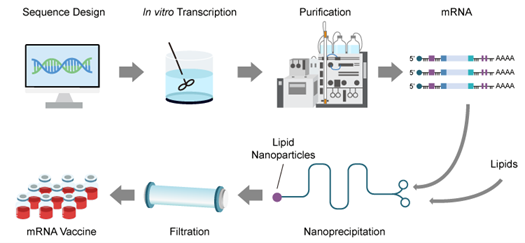
The production of mRNA-based vaccines is a highly efficient, cell-free chemical process.
-
Target Gene Selection: Scientists first identify the viral protein that will trigger an immune response. This gene sequence becomes the template for the mRNA.
-
Designing the mRNA Sequence: The DNA sequence of the target protein is converted into a corresponding mRNA sequence. Modifications can be added to improve stability and translation efficiency in human cells.
-
In Vitro Transcription (IVT): Using laboratory techniques, the mRNA is synthesized in vitro from the DNA template. This process, known as in vitro transcription, produces large quantities of the desired mRNA without using live viruses.
-
Purification: The synthesized mRNA is purified to remove residual enzymes, DNA templates, and other contaminants.
-
Formulation with Lipid Nanoparticles (LNPs): The purified mRNA is encapsulated in lipid nanoparticles. These nanoparticles protect the mRNA from degradation and facilitate its delivery into human cells.
-
Quality Control and Testing: Every batch undergoes strict quality control, including tests for purity, potency, and sterility, to ensure safety and consistency.
-
Filling and Packaging: The final mRNA-LNP formulation is filled into vials or syringes under sterile conditions, ready for distribution and administration.
How Do mRNA Vaccines Work?
How do mRNA vaccines work once injected into the human body? The process relies on proper mRNA function and targeted delivery mechanisms.
1. Entry via Lipid Nanoparticles (LNPs)
The synthetic mRNA is enclosed in lipid nanoparticles. These tiny particles protect the mRNA and help it cross cell membranes safely.
2. Cellular Translation
Once inside the cell, the mRNA is read by ribosomes, which act as cellular machines that translate the genetic instructions. The mRNA function here is to direct cells to produce the viral protein. In COVID-19 vaccines, this is the spike protein of SARS-CoV-2.
3. Immune System Activation
The newly produced viral protein is displayed on the cell surface or released, signaling the immune system. The body recognizes this protein as foreign and begins producing antibodies and activating T cells.
4. Formation of Memory Cells
Memory B cells and T cells are generated, providing long-term immunity. If the vaccinated individual encounters the real virus later, these memory cells enable a faster and stronger immune response.
mRNA vaccines never interact with the host DNA and degrade naturally after fulfilling their purpose.
Advantages of mRNA Vaccines
mRNA-based vaccines offer several advantages over traditional vaccines, including:
-
High Safety: Because these vaccines do not contain live, weakened, or inactivated viruses, there is no risk of the vaccine causing the disease it is designed to prevent. Furthermore, the active ingredients degrade naturally.
-
Rapid R&D and Production: The cell-free chemical manufacturing process is revolutionary. Once a novel pathogen’s genome is sequenced, a viable vaccine candidate can be digitally designed and physically produced in weeks.
-
Strong Immune Response: These vaccines stimulate robust and highly effective antibody and cellular immune responses that can protect against a wide range of illnesses.
-
Easily Adjustable: Pathogens continuously mutate. If a virus changes, scientists can simply swap out the specific genetic code in the vaccine formula to match the new variant. This is crucial for combating rapidly evolving pathogens.
-
Scalable Production: Synthetic mRNA production can be scaled efficiently in laboratory settings.
mRNA Synthesis | Synbio Technologies
Synbio Technologies provides highly efficient and cost-effective mRNA synthesis services. Our comprehensive, end-to-end service covers everything from initial sequence design and plasmid preparation to advanced RNA synthesis and LNP encapsulation, offering scalable production support for innovative drug and vaccine development.
-
One-stop service from sequence to LNP products.
-
Customizable sequences for various viral proteins
-
Utilizing an advanced AI sequence design platform for sequence analysis and codon optimization.
-
Delivering >95% purity verified by strict quality control standards, backed by a strict "No RNA, No Pay" guarantee.
-
Access to over 150 pre-validated mRNA sequences for accelerated testing.
Synbio Technologies provides the scalable, tailored solutions necessary to accelerate your biological discoveries. Contact us for more information!
Common Misconceptions About mRNA Vaccines
Despite the proven safety and effectiveness of mRNA vaccines, misconceptions persist:
1. mRNA Vaccines Will Alter Your DNA?
Fact: The mRNA does not enter the cell nucleus and cannot integrate into human DNA. It functions only as a temporary template for protein production and is then degraded.
2. mRNA Vaccines Have Severe Side Effects?
Fact: Most side effects are mild and short-term, such as injection site pain, fatigue, or low-grade fever. These reactions are signs that the immune system is responding.
3. mRNA Stays in the Body Long-Term?
Fact: mRNA molecules are transient. They are broken down naturally within hours to days after translation, leaving no lasting traces in the body.