
 DNA Synthesis
 Vector Selection
 Molecular Biology
 Oligo Synthesis
 RNA Synthesis
 Variant Libraries
 Genome KO Library
 Oligo Pools
 Virus Packaging
 Gene Editing
 Protein Expression
 Antibody Services
 Peptide Services
 DNA Data Storage
 Standard Oligo
 Standard Genome KO Libraries
 Standard Genome Editing Plasmid
 ProXpress
 Protein Products
At Synbio Technologies, we focus on providing comprehensive solutions for DNA construction through Whole Gene Synthesis and Custom Plasmid Synthesis. DNA fragment synthesis forms the cornerstone of modern synthetic biology, enabling researchers and industrial teams to create defined DNA sequences for diverse applications. By assembling short, precisely designed DNA fragments, we can construct larger genes or plasmids that are essential for experimental studies and biotechnological developments. Our platform allows for high-fidelity synthesis while ensuring compatibility with downstream assembly techniques, making it easier for research teams to explore new genetic designs safely and effectively.
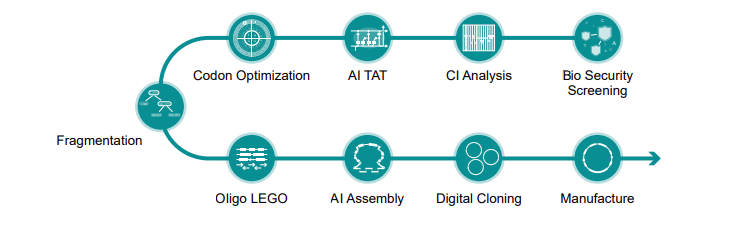
Designing and Building DNA Fragments
We begin every project by carefully designing DNA fragments to meet specific experimental or industrial requirements. Using our Whole Gene Synthesis capabilities, we can combine these fragments into complete gene sequences, which researchers can then use to study protein function or regulatory mechanisms. Meanwhile, our Custom Plasmid Synthesis services integrate these fragments into plasmid backbones suitable for expression or functional studies. This approach ensures accurate sequence replication and reduces the likelihood of errors during assembly. By focusing on design precision and methodical synthesis, we support our clients in achieving reliable outcomes across both research and applied biotechnology projects.
Practical Applications Across Industries
DNA fragment synthesis has broad applications in academic research, industrial biotechnology, and pharmaceutical development. Our Whole Gene Synthesis services enable rapid exploration of novel genes, metabolic pathways, and synthetic circuits, while Custom Plasmid Synthesis supports cloning strategies and gene expression testing. In industrial biotech, these methods help accelerate enzyme optimization, metabolic engineering, and production of bio-based materials. For pharmaceutical research, synthesized DNA fragments allow development of vectors and constructs critical for preclinical studies. Through these applications, we empower research teams to iterate quickly, validate hypotheses efficiently, and maintain high experimental reproducibility across multiple projects.
Advancing Research Efficiency and Collaboration
At Synbio Technologies, we recognize that time and precision are essential for modern research. Our DNA fragment synthesis platform integrates Whole Gene Synthesis and Custom Plasmid Synthesis into a seamless workflow, enabling scientists to move from design to functional testing without unnecessary delays. This integration also fosters collaboration, as synthesized DNA can be shared between teams while maintaining sequence fidelity. By providing a reliable and scalable solution, we help researchers focus on innovation rather than troubleshooting synthesis issues. Our system supports a wide range of studies, from gene function analysis to complex synthetic biology projects, promoting efficiency and reproducibility across the life sciences.
Conclusion: Enabling Innovation Through DNA Synthesis
In conclusion, DNA fragment synthesis is a foundational technique that drives innovation in research and industrial biotechnology. With our Whole Gene Synthesis and Custom Plasmid Synthesis services, Synbio Technologies offers a robust platform for accurate gene construction and plasmid development. By combining precise design, reliable assembly, and scalable production, we empower scientists and industrial teams to advance their work with confidence. As synthetic biology continues to expand, these tools play a critical role in accelerating discovery, enabling reproducible experimentation, and supporting innovation across diverse applications in research and industry.