
 DNA Synthesis
 Vector Selection
 Molecular Biology
 Oligo Synthesis
 RNA Synthesis
 Variant Libraries
 Genome KO Library
 Oligo Pools
 Virus Packaging
 Gene Editing
 Protein Expression
 Antibody Services
 Peptide Services
 DNA Data Storage
 Standard Oligo
 Standard Genome KO Libraries
 Standard Genome Editing Plasmid
 ProXpress
 Protein Products
At Synbio Technologies, we work closely with researchers and diagnostic developers who rely on precise nucleic acid tools for in vitro diagnostics. Antisense oligonucleotides are widely used in assay development, target validation, and signal modulation, making ASO Synthesis an important technical foundation. UnderstandingHow do antisense oligos work is essential when designing reliable diagnostic workflows, especially in environments where reproducibility and sequence integrity directly influence results. Based on our experience supporting laboratory applications, we summarize five key considerations that matter most when applying Antisense oligo synthesis in diagnostic research settings.
Sequence Design and Target Specificity
One of the first considerations inASO Synthesis is careful sequence design. Antisense oligonucleotides function by hybridizing to complementary RNA sequences, and this mechanism explains How do antisense oligos work at a molecular level. For in vitro diagnostics, specificity is critical, as even small mismatches may affect assay signals or interpretation. We evaluate target regions for accessibility, secondary structure, and off-target risk during Antisense oligo synthesis to help ensure consistent binding behavior. Thoughtful design allows ASO Synthesis to support diagnostic assays that require clear, interpretable molecular interactions without introducing ambiguity.
Chemical Modifications and Stability
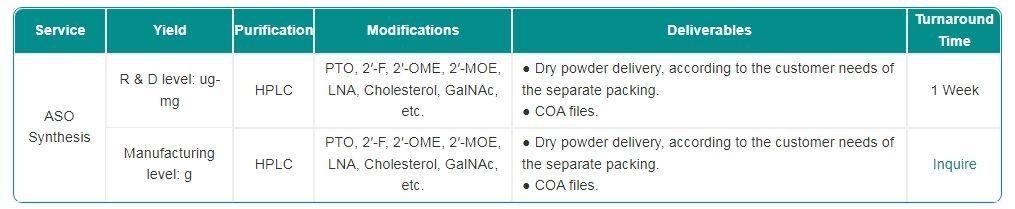
Another important factor in Antisense oligo synthesis is chemical modification strategy. In diagnostic environments, oligonucleotides often need improved stability during storage, handling, and assay execution. Different backbone or sugar modifications can influence binding affinity and nuclease resistance, which directly affects How do antisense oligos work under experimental conditions. During ASO Synthesis, we help researchers select modification options aligned with their in vitro diagnostic goals, balancing molecular stability with predictable hybridization behavior to maintain assay consistency.
Manufacturing Quality and Reproducibility
High manufacturing quality is a core consideration for ASO Synthesis used in diagnostics. Batch-to-batch consistency ensures that assay performance remains stable across experiments and time points.Antisense oligo synthesis requires controlled production processes, accurate purification, and rigorous quality checks to reduce variability. We apply standardized workflows throughout ASO Synthesis to support reproducible diagnostic development. Understanding How do antisense oligos work also guides quality control, as structural integrity and purity directly influence hybridization performance in vitro.
Regulatory Awareness and Application Fit
In vitro diagnostics often operate within defined regulatory frameworks, making application alignment another key consideration. While Antisense oligo synthesis itself is a technical process, its output must match the intended diagnostic use, including research-use-only settings. ASO Synthesis should be documented, traceable, and adaptable to evolving assay requirements. We align our Antisense oligo synthesis services with diagnostic research practices so that teams can integrate ASO tools smoothly into their workflows while maintaining transparency around how the oligonucleotides function and perform.
Conclusion: Integrating ASO Synthesis into Diagnostic Development
In summary, effective ASO Synthesis for in vitro diagnostics depends on sequence design, chemical stability, manufacturing consistency, and application awareness. By understanding How do antisense oligos work, researchers can better align Antisense oligo synthesis decisions with diagnostic objectives. AtSynbio Technologies, we support ASO Synthesis through structured design guidance and controlled production practices that fit diagnostic research needs. As diagnostic technologies continue to evolve, thoughtful ASO Synthesis remains a practical and adaptable component within in vitro assay development at Synbio Technologies.